Honesty vs loyalty: what each one means, examples and how to decide when they clash
By Juan Alejandre · Published · Reviewed
Industrial engineer and consultant, 25 years working with teams
Most days, honesty and loyalty get along fine. You tell the truth to people you are loyal to, and nobody notices there was ever a choice. The problem appears on a specific kind of day: a friend asks you to keep quiet about something, a colleague bends the numbers, a relative wants you to say they were with you when they were not. Telling the truth would hurt someone you care about; protecting them means saying less than you know.
This page defines both values, shows three made-up scenes where they collide (work, friendship, couple) and gives you five questions to decide when it happens to you. At the end, there is a way to see which of the two usually weighs more for you, before the next dilemma arrives.
What honesty and loyalty mean
Honesty is keeping what you say and do in line with what you know to be true: not deceiving, not leaving a false impression on purpose. See the entry for honesty.
Loyalty is staying on the side of a person, group or commitment when it costs you something, especially when they are not around to see it. See the entry for loyalty.
Two clarifications avoid most confusion:
- They are not opposites. Both can be present in one act. You can be loyal to a friend by being honest with them when everyone else tells them what they want to hear.
- They collide only in specific situations. When what you know could harm someone you are loyal to, or when staying loyal means saying something untrue or omitting something that matters.
That is why this is a dilemma and not a quiz with a right answer: both values are worth having, and in a clash one of them pays a price.
Three scenes where they clash
These are made-up examples, written to show the tension, not to say what anyone should do.
At work: the colleague who rounds up the figures
Example. Nora has worked for three years with Pablo, who helped her when she was new. Before a client presentation, she notices he has rounded a sales figure up so the result looks better. It is a small difference, but it is not what the data says.
- What honesty asks. Do not present the number as it is, and do not let others rely on it.
- What loyalty asks. Do not go over his head, and give him the chance to fix it.
- A way through that often exists. Talk to Pablo before the meeting: "That number is not the one in the report; I cannot present it like that." This respects the relationship and the truth at once. The real dilemma begins only if he refuses, and then the question is whether your loyalty is to him or to the team and the client who will use that number. For more situations like this one, see values at work.
With a friend: the plan they asked you to keep secret
Example. Iris tells Marcos she is going to quit her job without telling her family, and asks him not to say anything. A week later her sister asks Marcos directly: "Do you know if Iris is okay?"
- What honesty asks. Do not lie to the sister.
- What loyalty asks. Keep Iris's confidence.
- The useful distinction. Not saying and lying are different acts. Marcos can answer, "That is for Iris to tell you; talk to her." He keeps the secret without inventing anything. What he cannot do without crossing a line is answer, "No, I know nothing." Many dilemmas look smaller once you separate omitting from deceiving.
As a couple: the thing you saw
Example. Elena sees Tomás, a close friend of her partner Leo, in a situation that suggests he is hiding something from his own partner. Leo would be very hurt to learn it from someone else.
- What honesty asks. Not hiding what she saw from Leo.
- What loyalty asks. Not repeating something she is not sure she understood, and not harming Tomás based on an impression.
- What changes the weight. How certain she is of what she saw, whether the matter is hers to share, and whether someone could be harmed by not knowing. Being unsure is a good reason to wait and ask, not to speak or to stay silent forever. This scene has no clean answer: reasonable people would act differently.
Five questions to decide when they collide
None of these gives you the answer; they help you see the situation more clearly before acting.
- Who could be harmed, and how seriously? A bruised ego, a lost contract, a safety risk and a legal matter do not weigh the same. When the harm falls on third parties who cannot defend themselves, honesty usually gains weight.
- Is it a lie or an omission? Keeping something private is not the same as deceiving. If you can stay loyal without saying anything false, start there.
- Whose information is it? A secret someone entrusted to you is different from something you discovered yourself, and both differ from something that affects people who rely on you.
- Can you go to the person first? Giving them a chance to put it right or explain often satisfies both values. It is the most common way out and the least used.
- Can you stand behind your choice in a year? Picture explaining what you did to the person you most respect. If you would be uncomfortable, look at what exactly bothers you.
Two warnings. Loyalty that requires lying again and again is no longer loyalty to a person but to a habit of covering things. And honesty used as a weapon ("I am only being honest") is not a virtue; telling the truth well includes thinking about timing, manner and purpose, which is where kindness helps.
The same questions work for neighbouring pairs people also search. With integrity versus loyalty, the clash comes when your group expects something that goes against your principles. With trust versus loyalty, it comes when someone you trust has done something you cannot accept. With justice versus loyalty, it comes when helping one of your own means treating another unfairly.
Which one weighs more for you?
Thinking about these scenes in general is easy; deciding with a name and a face attached is harder. A more reliable way to know your tendency is to choose between the two values over and over without time to build a justification.
The top10values game does exactly that: 100 comparisons between two values, with no account needed to start, and an ordered Top 10 at the end. Look at where honesty and loyalty land. If both are high, you will probably feel these dilemmas strongly, and it is worth deciding in advance what you do in each type of situation. If one is clearly above the other, it does not mean you are right or wrong; it is a pattern worth knowing. The methodology page explains how the result is calculated. The game is a self-knowledge tool, not a validated psychological test, and your Top 10 changes with your circumstances.
For a wider view, the personal values list has 50 values to compare, and the personal values test explains how to read the result.
Frequently asked questions
What is the difference between honesty and loyalty?
Honesty is about the truth of what you say and do; loyalty is about staying on someone's side or keeping a commitment. One concerns what you tell, the other whom you are faithful to. They conflict only when telling the truth would betray someone, or loyalty would require deceiving.
Which is more important, honesty or loyalty?
There is no answer valid for everyone. It depends on the situation (how much harm and to whom), on the relationship and on which value you hold higher. It helps to know your own tendency beforehand, so a hard moment does not catch you without a criterion.
Can you be honest and loyal at the same time?
Often, yes. Most dilemmas have a route that honours both: speaking to the person directly, declining to answer instead of lying, or telling the truth in a way that protects the relationship. The real choice between them is rarer than it seems.
Next step
Play the values game and see where honesty and loyalty sit in your own Top 10. If you want to read more first, browse the full list of values.
Sources
Find your top 10 values with 100 quick comparisons
What does the paid report include?
When you finish the 100 comparisons you will see your Top 10 on screen. If you want to go further, there is a PDF report on your personal values: €9.95 (VAT included), one-off payment. To buy it you need to save your game with a Google account.
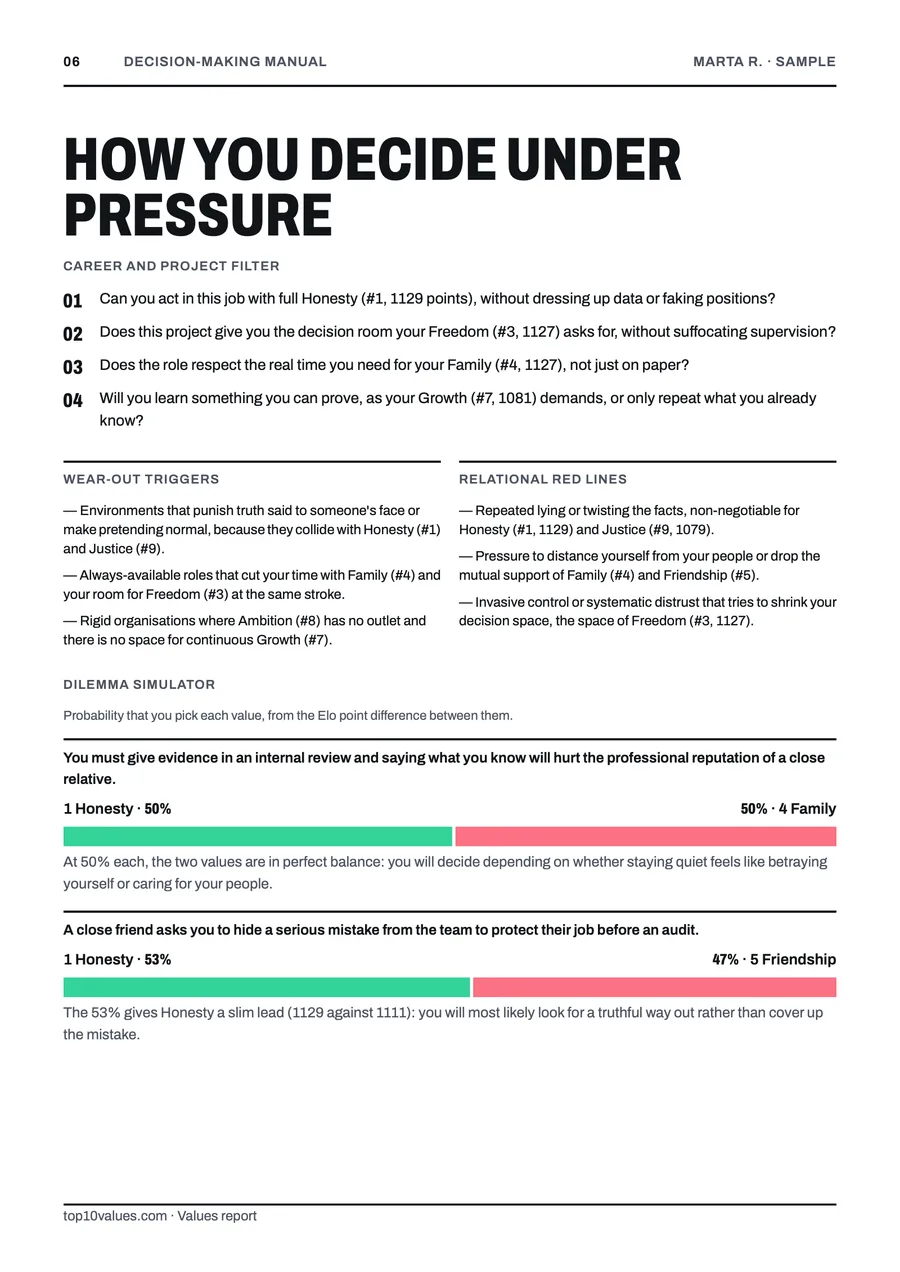
Sample page with fictional data (Marta R.), not yours. Your report is written from your own choices.