List of personal values: 50 examples and how to choose your core values
By Juan Alejandre · Published · Reviewed
Industrial engineer and consultant, 25 years working with teams
Most lists of personal values have the same problem: you read down the page and everything looks important. Honesty, health, family, freedom: who would say no to any of them? A list can tell you which words exist, but not which ones win when two of them pull in opposite directions.
This page gives you both things. First, the 50 values we use at top10values, grouped by area, with one concrete sign of what each looks like in everyday life. Then a four-step method to narrow the list down to your own core values, including a pairwise exercise you can do with a pen and paper. If you would rather let the top10values game do the ranking, you can go straight to it at the end of the page.
What is a personal value (and what is not)?
A personal value is a direction you choose to follow: something you consider important that guides your decisions even when nobody is watching. Three contrasts make it easier to spot one:
- A value is not a goal. "Finish my degree" is a goal: you complete it and it is over. "Learning" is a value: it is still there after graduation and explains why you enrolled in the first place.
- A value is not a rule. "Never lie" is a rule of conduct. Honesty is the value underneath it, the reason a lie bothers you even when no one would find out.
- A value is not a personality trait. You can be a shy person and care deeply about courage. Values describe where you want to head, not how you are wired.
A simple test: a real value costs you something. If you have never given anything up for it, it may be a value you like, but not one that moves you.
A list of 50 personal values, grouped by area
Each value comes with one line on how it shows up in practice. These are signs to help you recognize yourself, not dictionary definitions. Each name links to its own page, with its meaning, its downside when taken too far, and how to live it. The groups only organize this page; they do not match one-to-one the categories of the radar you see at the end of the game.
Relationships
- Family: you plan your calendar around the people at home, not the other way around.
- Love: you look for deep bonds and accept the risk of getting hurt in exchange for them.
- Friendship: you look after your friends even when there is no practical reason to.
- Trust: you would rather delegate and give people room than double-check everything.
- Loyalty: you stay by someone's side when walking away would be easier.
- Empathy: before replying, you try to understand what the other person is feeling.
- Kindness: how you treat people does not depend on what they can do for you.
- Respect: you hear out people who disagree with you, even if you do not change your mind.
Integrity and character
- Honesty: you say what you think even when it is not the answer people hoped for.
- Integrity: what you do in private matches what you defend in public.
- Justice: an unfair split bothers you even when it works in your favor.
- Humility: you admit a mistake without needing to be shown three times.
- Courage: you do what you believe is right even when your knees shake.
- Authenticity: you do not change your opinion depending on who is in the room.
Growth and knowledge
- Growth: you compare yourself more with who you were a year ago than with other people.
- Learning: there is always a book, a course or a question in progress.
- Curiosity: you ask "why?" more often than some people would like.
- Wisdom: before deciding, you take time to look at the problem from a distance.
- Self-awareness: you want to understand why you react the way you do.
- Discipline: you do what you set out to do on the days you do not feel like it.
- Mastery: you would rather get really good at one skill than dabble in many.
Achievement, work and resources
- Ambition: big challenges motivate you and the bare minimum never feels enough.
- Success: you care about reaching specific goals that can be measured.
- Excellence: you hand something in when it is good, not merely when it is finished.
- Efficiency: wasted effort annoys you and you look for the shortest route.
- Productivity: you judge a day by what you got done.
- Leadership: when nobody steps up, you tend to be the one who does.
- Recognition: it matters to you that your work is seen and valued.
- Financial security: an emergency fund calms you more than any treat.
- Wealth: you aim for a level of prosperity that opens up options.
Freedom
- Freedom: you need to decide how, when and with whom you do things.
- Independence: you would rather solve things yourself than depend on others.
- Adventure: the unknown attracts you more than it scares you.
Creativity and expression
- Creativity: you struggle to follow a recipe without changing something.
- Imagination: you enjoy thinking about how things could be.
- Innovation: you like taking a new idea all the way until it works.
- Originality: you avoid what everyone else does just because everyone else does it.
- Self-expression: you need to get what you think out into the world, in writing, in conversation or by making things.
- Beauty: order, aesthetics and small details change your mood.
Wellbeing
- Health: you protect sleep, movement and food even when your schedule is packed.
- Balance: you worry about one area of your life swallowing all the others.
- Inner peace: you avoid unnecessary conflict and look for moments of calm.
- Happiness: you often ask yourself whether what you are doing feels good.
- Enjoyment: you know how to stop and savor what is happening right now.
- Gratitude: you notice what you have before what is missing.
- Simplicity: you prefer fewer things and fewer commitments, chosen on purpose.
- Vitality: you feel best when you have energy and keep moving.
Meaning and contribution
- Purpose: you need to know what you are doing it for.
- Contribution: you want to leave things a little better than you found them.
- Service: helping other people directly gives you a sense of meaning.
No list is complete. You may miss a few (responsibility, patience or spirituality, for example). If so, write them down: what matters is not whether the word is on this page, but that you choose it deliberately.
Values that look alike
Several values are easy to mix up when you choose:
- Success, ambition and wealth. Ambition is the drive, success is reaching a specific goal, and wealth is a resource. You can be ambitious without caring about money.
- Freedom and independence. Freedom is deciding how you live; independence is not needing anyone to do it. Plenty of people love freedom and still ask for help without any trouble.
- Honesty and integrity. Honesty is about what you say; integrity is about whether what you do fits what you stand for.
- Happiness and enjoyment. Happiness is an overall verdict ("am I okay with my life?"); enjoyment is being at ease in this moment.
- Balance and inner peace. Balance spreads your time across areas; inner peace is how you feel inside, even on a full calendar.
Values that collide
Values show up most clearly when they clash. Some common collisions:
- Honesty versus kindness. A friend shows you a project you are not convinced by. Telling the whole truth and protecting their excitement do not always fit in one sentence.
- Ambition versus balance. You are offered a role with more responsibility and fewer evenings off. Accepting it adds to one value and takes from the other.
- Family versus freedom. A job offer in another city against the idea of living near your people.
- Loyalty versus justice. Someone close to you does something wrong. Do you back them or call it out?
- Financial security versus adventure. Leaving a steady job for an uncertain project.
If you recognize yourself in one of these dilemmas, you already know which values to compare first in step 3. If the clash you are dealing with is at work, the guide to values at work has concrete scenes and signs to spot it.
How to choose your core values from the list
Choosing values has a trap: if you ask yourself "is this important to me?", the answer is almost always yes. The more useful question is "if I had to pick between this and that, which one would I keep?" The four steps below are built on that idea.
Step 1: make a first cut
Read the list and mark 12 to 15 values. Be strict: mark only those you have already given something up for, whether money, time, comfort or someone's approval. If you hesitate, leave it unmarked; you can always come back.
Step 2: check against recent decisions
Think of three important decisions from the last two years: a job change, a breakup, a move, a "no" that was hard to say. For each one, write down which value won. If "adventure" made your first cut but financial security won all three decisions, that gap is useful information. It does not mean adventure is fake; it means it currently weighs less than you thought.
Step 3: compare in pairs
Keep your 8 clearest values and compare them two at a time. Eight values make 28 pairs. For each pair, ask: "if I could only protect one of these two for the next year, which would it be?" Give the chosen value one win. At the end, rank them by number of wins.
An example with these 8 values: family, honesty, health, freedom, learning, financial security, adventure and recognition. After the 28 choices, the tally might look like this:
| Value | Wins |
|---|---|
| Family | 6 |
| Honesty | 6 |
| Health | 5 |
| Freedom | 4 |
| Learning | 3 |
| Financial security | 2 |
| Adventure | 1 |
| Recognition | 1 |
The wins add up to 28, one per pair. When two values tie, as family and honesty do here, look at which one you chose when they faced each other: that breaks the tie. This tally is invented to illustrate the method; it is not anyone's real result. It still shows something the list alone would not: adventure, which sounds great as an idea, loses almost every time it faces something concrete.
This is, by hand, the principle behind the top10values game: comparing in pairs instead of rating from 1 to 10. The digital version does it with all 50 values. Each starts at 1,000 points, like a chess player who has not played yet (this is the Elo rating system), and every choice moves one value up and the other down. If you pick the value that was already ahead, the change is small; if you pick the one that was behind, it is bigger, so a surprising choice counts for more than a predictable one. The game also picks the most informative pair each time, mixing values with similar scores, values that have come up few times and pairs you have not seen yet. The details, with the numbers, are on the methodology page.
Step 4: test them for a week
With your top 5 written down, ask one question every evening for a week: "what did I do today that fits one of these?" If a value does not appear even once in seven days, ask yourself whether it is a value you live or one you would like to live. Both are legitimate, but it helps not to confuse them.
Common mistakes when building your list
- Picking the ones that sound good. Honesty, respect and empathy appear on a huge number of lists because nobody wants to look like the opposite. If you pick them, let it be because they survive the pairwise test, not because they look good on paper.
- Mixing up values and goals. "Buying a house" is a goal. Behind it there may be financial security, family or independence, and knowing which one helps you decide which house, where and when.
- Copying your company's values. Corporate values describe how an organization wants to operate. They may overlap with yours, but they do not replace them. If you have an interview coming up, the guide to values in a job interview shows how to bring yours prepared.
- Assuming they last forever. Your priorities shift with age, children, illness or a move to another country. Repeating the exercise after a while is not inconsistency; it is updating the map.
- Keeping too many. Fifteen values will not guide any decision. Five to ten is a workable number.
- Choosing what you wish were true. It is easy to write down the values of the person you would like to be. Step 2 exists to check them against what you have already done.
Frequently asked questions
How many personal values should I have?
There is no right number, but five to ten works well. With fewer, the list leaves out parts of your life. With more, it stops helping you decide, because there will always be a value that justifies any option. At top10values we work with an ordered Top 10, so you also know which come first.
What is the difference between personal and professional values?
Professional values are the part of your values you apply at work: excellence, efficiency, leadership or recognition, for example. They are not a separate set. If work asks you to act against a strong personal value such as honesty, you will feel it even if that value is not in your contract. More examples in the guide to values at work.
Do values change over time?
Your priorities can change with life stages: having children, changing careers, going through an illness or moving abroad often shift the order of your list. That is why it is worth revisiting it from time to time. A new order does not mean you were wrong before; it means your situation is different.
Are some values better than others?
Not on a list like this one. Valuing wealth or recognition does not make you a worse person than valuing service. The real risk is too much of any value: trust taken to the extreme becomes gullibility, and discipline becomes rigidity. Each value page covers its downside.
How do I find out what my core values are?
The four steps on this page can give you a fairly clear picture in an afternoon. If you would rather let the order emerge from many quick choices than from a long reflection, try the game, and read first how it works in the guide to the personal values test.
Is this a psychological test?
No. It is a tool for thinking about what matters to you, not an assessment or a diagnosis, and it does not compare your answers with anyone else's. The methodology page explains what it does and what it cannot tell you.
Try ranking all 50 values
The list gives you the words; the comparisons give you the order. In top10values you choose between two values at a time, by tapping or swiping. After 100 comparisons your ordered Top 10 unlocks, along with a radar by category. Seeing your result has no charge; the only paid item is an optional extended report. You can start without creating an account; Google sign-in is only asked at the end, if you want to save your game, share the result or buy that report. It is a starting point for thinking about what really matters to you, not a diagnosis.
Sources
Find your top 10 values with 100 quick comparisons
What does the paid report include?
When you finish the 100 comparisons you will see your Top 10 on screen. If you want to go further, there is a PDF report on your personal values: €9.95 (VAT included), one-off payment. To buy it you need to save your game with a Google account.
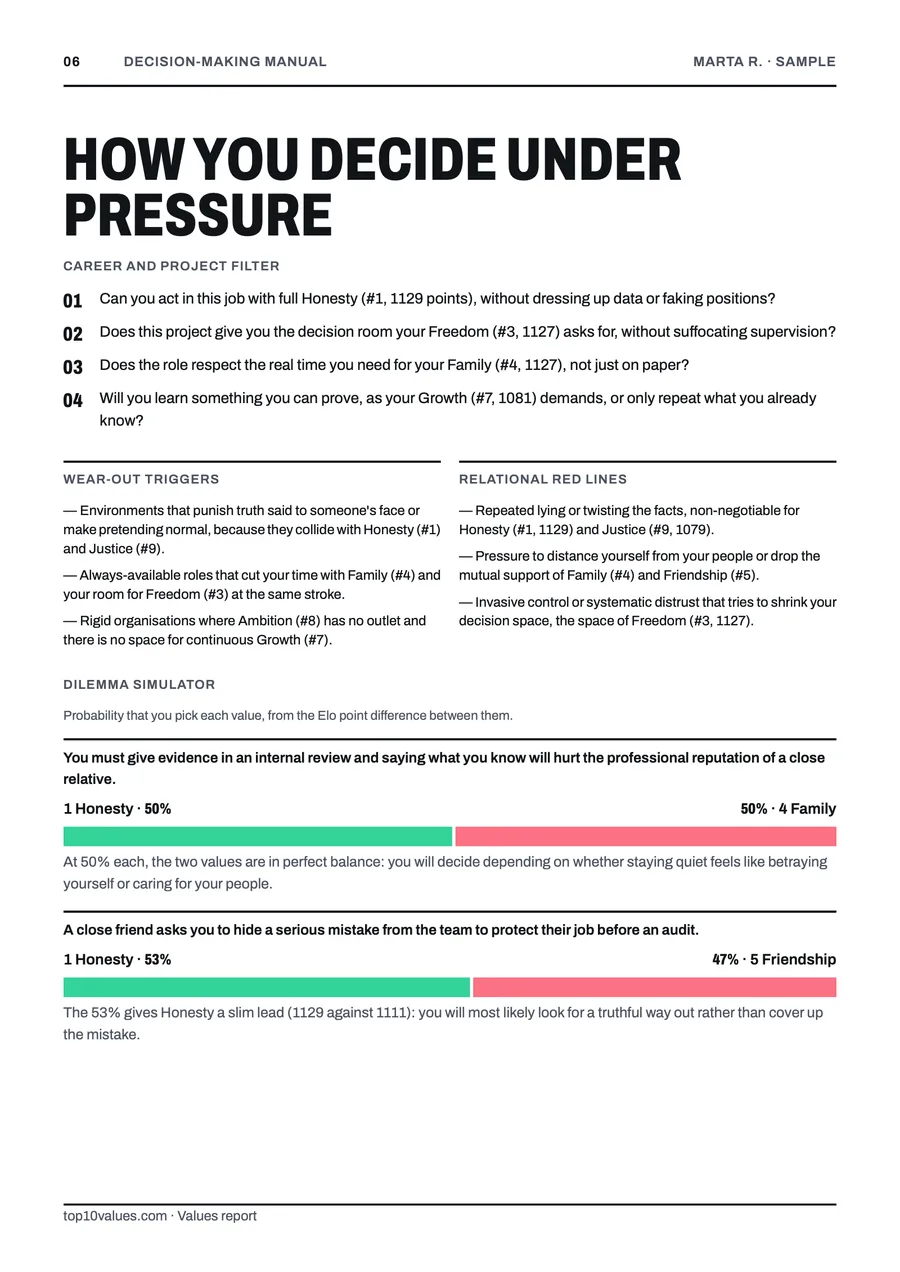
Sample page with fictional data (Marta R.), not yours. Your report is written from your own choices.