Wellbeing
Vitality
Energy and enthusiasm for life.

Vitality is the energy and active enthusiasm for living, shown in the willingness to move, take part and make the most of your time with physical and emotional intensity. People who value vitality seek to stay active, avoid stagnation and often spread their positive energy to those around them in different areas of life. This value is closely linked to physical health, but it also includes an attitude component: some people in good physical condition lack vitality, and others radiate it despite limitations. Prioritizing vitality means consciously choosing movement, participation and enthusiasm over the comfort of passivity.
What does this value mean?
Vitality, as a value, means taking your energy, and your appetite for your own life, seriously: arriving at the things that matter to you with energy to spare, not with the scraps left over at night. It is measured less by how much you do than by the state you do it in. Some packed weeks leave you feeling switched on inside, while some quiet weeks make everything twice as hard. When vitality sits high on your list, one simple question finds its way into most of your decisions, from accepting a job to choosing what to do on Saturday: “does this light me up or drain me?” And the answer carries as much weight as the salary, the obligation or what people will think.
A few people make the idea clearer than any definition. The postal worker of fifty-eight who, halfway through the round, still has the breath to ask the woman at number fourteen how her hip is, because he has learned to save something for people. The software developer who realised her brain switches off after three in the afternoon and moved the hard problems to the morning, instead of fighting herself every day. The eighty-two-year-old who never misses the dance at the village summer fête, even if she only lasts three songs, because those three songs carry her through the week. And the father of two small children who guards his twenty minutes on the bike on Sunday morning like treasure, because he knows that without them he reaches Monday with no patience left. None of them is permanently full-on. What they share is taking their energy seriously: noticing it, knowing where it comes from and where it leaks away, and arranging life so that what matters most gets the best of it. In 1997 the psychologists Richard Ryan and Christina Frederick studied what they called “subjective vitality”, a positive feeling of aliveness and energy, linked to the energy available to the self. That idea of energy available for your own ends is the heart of this value: vitality is not rushing around or running on nerves, it is having strength for what you choose.
What it does NOT mean
It is not hyperactivity. A crowded diary, fast talking, replying to messages at midnight and stacking plan on plan can look like energy and actually be avoidance or plain nervousness; plenty of very busy people feel hollow inside. Nor is it the same as health. You can have perfect blood tests and live with no spark, and you can live with a chronic illness and have remarkable vitality in the hours your body allows. It is not extroversion or being the life of the party: some quiet people have a calm, steady energy that lasts for decades. Nor is it permanent good cheer, or demanding enthusiasm from people who do not have it; tiredness, sadness and grey days belong in a vital life too. And it is not willpower. Discipline can push you along for a while without any vitality, but that reserve runs out; vitality is what means you do not have to push quite so hard.
Related concepts
Why might it matter to you?
Almost everything you value needs energy to exist. Patience with your children, kindness towards an awkward customer, creativity on a project, the serious conversation you have been putting off for weeks: all of it draws on a shared reserve, and when that reserve is empty your other values stay as good intentions. That gives vitality an unusual place in a top 10. It does not so much compete with your other values as hold them up or let them drop. Treating vitality as a value changes the question you ask when you are worn out. Instead of “what is wrong with me, why can't I cope?”, which usually ends in guilt, you ask “what is draining me and what gives energy back?”, which leads to concrete decisions about a timetable, a relationship, a phone habit or a weekly meeting that could be an email. It also matters because a lack of vitality rarely arrives as a crisis. It settles in as a grey tone where nothing is exactly wrong but nothing appeals, and with vitality high on your list that grey stops being “just what happens at my age” and becomes a signal.
How can you live this value?
- Map your energy for two weeks. Three times a day, say when you wake up, after lunch and at eight in the evening, jot down a score from one to five and what you have just been doing. No app needed; a note on your phone will do. After fourteen days you will see patterns you currently only half sense: which meetings leave you at a two, which walk lifts you to a four, what time your concentration falls off a cliff. Without that map, every change is a guess.
- Put what matters most into your high-energy hours. If you are a morning person, do not leave the writing, the studying or the important conversation for the evening, when you only have enough left to load the dishwasher. If you come alive later, push for a later start or keep the first hour for routine tasks. Nobody has the same strength at every hour, and handing your best hours to email or social media is one of the most common ways to lose vitality without noticing.
- Name your three biggest energy leaks and close one a month. A leak might be a person who always leaves you feeling flat, a habit such as reading the news in bed, a commitment that no longer makes sense or a task you do out of inertia. Pick the easiest, give it a date and check your map to see whether it shows. Often the biggest leak is the one you find hardest to say out loud.
- Design breaks that genuinely recharge. Switching screens is not resting: going from laptop to phone keeps your head stuck in one gear. A break that recharges usually means changing your body and your surroundings: five minutes outside, a stretch, looking at something far away, talking to someone about anything but work. Keep the ones your map confirms.
- Keep at least one activity that lights you up and serves no purpose at all. Dancing in the kitchen, playing the guitar badly, wandering round a market with no list, five-a-side with people from your street, looking after a few plants. When life fills up with obligations, the first thing cut is whatever gives energy without producing results, and that is a miscalculation: those activities feed everything else. Put it in your calendar as you would a doctor's appointment.
- Learn to tell good tiredness from bad. After a long hike, helping a friend move house or a day in the garden, your body aches and yet your mood is good; after six hours of video calls you have barely moved and feel there is nothing left inside. Both are called tiredness, but they tell very different stories about your week. If most of your days end with the second kind, you are not short of rest; you are short of the first kind. And if exhaustion lasts for weeks with no clear reason, book an appointment with your GP, because low energy can have physical causes that are worth ruling out.
Advertisement
What happens when you don't live up to this value?
When vitality is neglected, life keeps running, but in power-saving mode. You keep up with work, the house and the family, and by the time you get to anything for yourself there is nothing left. Plans that used to excite you turn into commitments you cancel with relief. The weekend is spent recovering from the week, and Monday starts again with your batteries still flat. A familiar vocabulary appears: “I'm shattered”, “I'm too old for that”, “once this busy patch is over”, and the busy patch never ends. At work, low vitality is mistaken for poor motivation or lack of talent, when it is often plain accumulated exhaustion. And in the long run you stop imagining change at all, because any change seems to demand an energy you do not have. Low vitality feeds itself, which is why it is worth catching early.
The healthy side and the shadow
When does this value stop helping you and start limiting you?
Healthy expression
Energy looked after and well spent
In excess
Living permanently at full throttle
The shadow side of vitality appears when it becomes an image you have to keep up. If you are known as “the energetic one”, you can end up with no permission to be tired, sad or simply unenthusiastic, and fake it in the office, among friends and on social media until the costume weighs more than the day. A second shadow is intensity as a habit you cannot do without: always needing a plan, a challenge, a mountain race or a trip in order to feel alive, so that ordinary days seem dead and rest feels like wasted time. A third is impatience with other people: getting irritated with a partner who needs more sleep, a friend who does not want to go out or a colleague with a slower pace, as if their energy were a failure of willpower. And there is a fourth, quieter one: ignoring your body because “you can handle anything”, until your body decides for you with an injury or a bout of exhaustion that stops you dead. To check that you are on the healthy side, look at three things: you can stop without feeling you are missing out, you accept low days without turning them into a drama, and you do not need anyone to see your energy in order to have it.
This value at work
At work, valuing vitality changes what you look at when you choose. Two jobs with identical salaries can be worlds apart in energy: one with a two-hour commute, late-afternoon meetings and messages at any hour, the other closer to home, with predictable hours and a team you enjoy. If vitality is high on your list, you ask at interview what a normal Tuesday looks like, not only what the targets are. Inside a role it shows in small things: blocking out the first hour for the work that needs a clear head, suggesting that a weekly meeting becomes fortnightly, walking during calls that do not need a screen, eating lunch away from your desk. Watch out for two traps. The first is job adverts asking for “a dynamic, high-energy self-starter”: sometimes that means a stimulating environment and sometimes it means enthusiasm is expected at all hours. The sociologist Arlie Hochschild coined the term “emotional labour” in The Managed Heart (1983) for the effort of displaying the feelings a job requires; holding a customer-facing smile for an eight-hour shift uses up energy, even though it never appears on a payslip. The second trap is confusing vitality with hours: staying late to prove your commitment usually takes away the energy you will need tomorrow.
This value in relationships
In friendship, vitality shows in who you spend time with and how you feel afterwards. With some friends you can spend three hours and still come home wanting to do things; with others a single drink leaves you flat for the rest of the evening. It is not always anyone's fault. Sometimes it is the kind of conversation (endless complaining, gossip, one-upmanship), sometimes the plan (always that loud pub until closing time), sometimes where each of you is in life. Taking this value seriously does not mean dropping people who are going through a rough patch; it means watching the overall balance of your social life so that it is not made up only of relationships that take. It helps to suggest plans that give both of you energy: a long walk instead of another late dinner, something you do together, a twenty-minute call instead of two hours of messages. It also helps to be honest about your energy: “I've got nothing left tonight, how about Thursday?” does more for a friendship than turning up with your mind elsewhere.
This value in love
In a couple, vitality shows up in the everyday before it shows up in romance. Two people with different rhythms (one who wakes up chatty and one who needs an hour of silence, one who wants to go out on Friday and one who only wants the sofa) can spend years reading those differences as a lack of interest. Naming them helps enormously: “it's not that I don't want to be with you, it's that by eleven at night I've got nothing left”. From there you can negotiate concrete things: keeping serious conversations for Saturday morning, alternating the kind of plans you make, accepting that one of you goes to bed earlier. Energy also affects desire and intimacy, and it often drops during years of young children, intense work or illness; talking about it without blame stops each of you taking it as personal rejection. Beware of one trap in particular: making your partner responsible for your vitality, expecting them to cheer you up, get you out of the house or give you back your appetite for life. A partner can pass energy on, but cannot replace the energy missing from the rest of your life.
This value in family
In family life, vitality changes a great deal with age, and it is worth looking at each stage. With small children, parental tiredness is almost unavoidable, and vitality is not about denying it but about protecting each other in shifts, so that every adult gets time to recharge without feeling they are stealing it. A mother who dances while she makes dinner or a father who suggests the park even in the drizzle teaches more about energy than any piece of advice. With teenagers, the temptation is to read their tiredness as laziness; sleep patterns commonly shift later in adolescence, and a conversation about timetables usually achieves more than a lecture about Saturday mornings. At the same time, if a teenager loses interest in everything for weeks, that is no longer laziness and it is worth seeking help. With older parents, vitality becomes delicate: shielding them from all effort can dim them faster than age does. Letting them keep making the Sunday roast or tending the allotment, even if it takes longer, respects their energy instead of replacing it. And if someone in your household is caring for a sick relative, that carer's vitality is a matter for the whole family, not a private problem to be solved with good will.
This value and yourself
With vitality high on your list, you are likely to notice very clearly when something is draining you, even if you do not always act in time. You may struggle to spend long periods in grey environments, around people with no spark, or in jobs where nothing ever changes, and you may have made choices that puzzled others (changing city, leaving a secure job, relocating closer to the sea or the hills) because you felt you could not breathe. Now the other side. Do you let people see you running on empty, or do they only ever meet your good days? Can you tell the energy something gives you from the excitement it triggers, which can feel very similar? Do you really rest, or do you just swap one intense activity for another? And if vitality is high on your list but you feel very little of it right now, that does not mean you picked the wrong value: what you value most is often exactly what you miss most.
What are you willing to sacrifice for this value?
Vitality costs things that most people are reluctant to give up. Would you turn down a promotion with better pay if you knew it would take your evenings and half your sleep? Would you leave a dinner with friends that you are enjoying, so as not to wreck the next day? Would you gradually step back from an old friendship that always leaves you low, even though you feel you owe them? Would you go to bed at half past ten even if it meant missing the end of the match or the next episode? Look back at the last few times vitality competed with money, image or the fear of letting people down. If it lost nearly every time, it is a value you defend in words more than in your diary. You do not need to win every one of those battles; it is enough for vitality to win some of them now and then, and for that to be your decision.
Signs you're betraying this value
Vitality is rarely lost in one go; it is betrayed by postponement. You know what gives you energy back and keep putting it off: the bike in the shed, the class you dropped, the call to the friend who always lifts you. You also betray it when you answer every sign of exhaustion with more coffee, more sugar or more screen time instead of asking what is causing it. Saying yes to everything and then arriving at what really matters with nothing left is another, very common, way of doing it. So is talking about exhaustion as a badge of honour, boasting about how little you sleep or how full your diary is. Some betrayals pass for good manners: staying out of obligation at events that drain you, or answering work messages on holiday because “it only takes a second”. And one betrayal passes for maturity: telling yourself that enthusiasm is for the young and that being an adult means putting up with things. If months have gone by since you last felt properly alive, it is not a phase; it is a signal. If it comes with persistent low mood or a feeling that nothing interests you, talk to your doctor or a mental health professional.
Turning the value into goals
Value
Vitality
Behavior
For two weeks, note three times a day how your energy scores from one to five and what you were doing, and at the end mark what pushed the score up and what pulled it down
Goal
Over the next three months, close one clear energy leak (a commitment, a habit or a schedule) and bring back one activity that lights you up, with a fixed slot in your calendar
Habit
A real ten-minute break away from screens every afternoon and one weekly slot kept for the activity that gives you your appetite back
Questions to reflect on
- Which moment in the past year made you feel truly alive, and what were you doing, who were you with and what time of day was it?
- Which three things in your week leave you drained, and which one could you change this month if you dared?
- At what time of day do you have the most energy, and what are you spending it on at the moment?
- Which people around you give you your enthusiasm back, and how much time do you actually spend with them?
- Which activity did you drop years ago because “there was no time”, and what do you notice when you picture taking it up again?
- If someone watched your life for a whole month, would they say you look after your energy or spend it on whatever shouts loudest?
How much are you living this value?
Pick two days from the past week: the one you remember with the most energy and the one that went by without leaving anything. What was different about the timing, the company and the tasks? Then give yourself a mark out of ten for how much of your best energy went to what matters most to you, rather than to whatever was most insistent. If you land below seven, do the two-week energy map before changing anything, and then choose a single leak to close.
When two values clash
Vitality clashes with Productivity when every minute becomes a gap to fill: optimising your morning, listening to a podcast on every walk and answering emails on the train can increase what you get done while draining the energy that only comes from doing something simply because you like it. With Financial security the dilemma comes in the shape of a payslip: the secure job that pays the rent may also be the one that dims you, and walking out is not always wise; often the way through is to find energy outside that job while you calmly prepare a change that puts no one at risk. With Service the clash shows up in people who care without cover, like the nurse on double shifts or the son who looks after his mother every evening: without recharging, care turns half-hearted. With Ambition the tension is about the calendar: a season of intense effort, such as a product launch or studying for a professional exam, can energise you for months as long as it has an end date; without one, what gave you life starts to consume it. With Inner peace there is a difference in temperature: peace seeks calm and vitality wants movement, and it is better to recognise what you need at each stage than to assume one must defeat the other. With Loyalty and Kindness the clash is more personal: staying in a group out of faithfulness even though it drains you, or accepting every request for fear of disappointing someone. Health is its closest ally, though they are not identical: health looks after your body over the long term, while vitality looks at how alive you feel today, and sometimes a night at a gig gives you life even if it costs you sleep. Adventure and Enjoyment feed it, and Balance gives it a frame: without balance, vitality tends to be spent entirely on one corner of life.
Is “Vitality” one of your top 10 values?
Find out by playing and comparing this value with the other 49
How the Elo ranking works and its limits in the methodology.
What does the paid report include?
When you finish the 100 comparisons you will see your Top 10 on screen. If you want to go further, there is a PDF report on your personal values: €9.95 (VAT included), one-off payment. To buy it you need to save your game with a Google account.
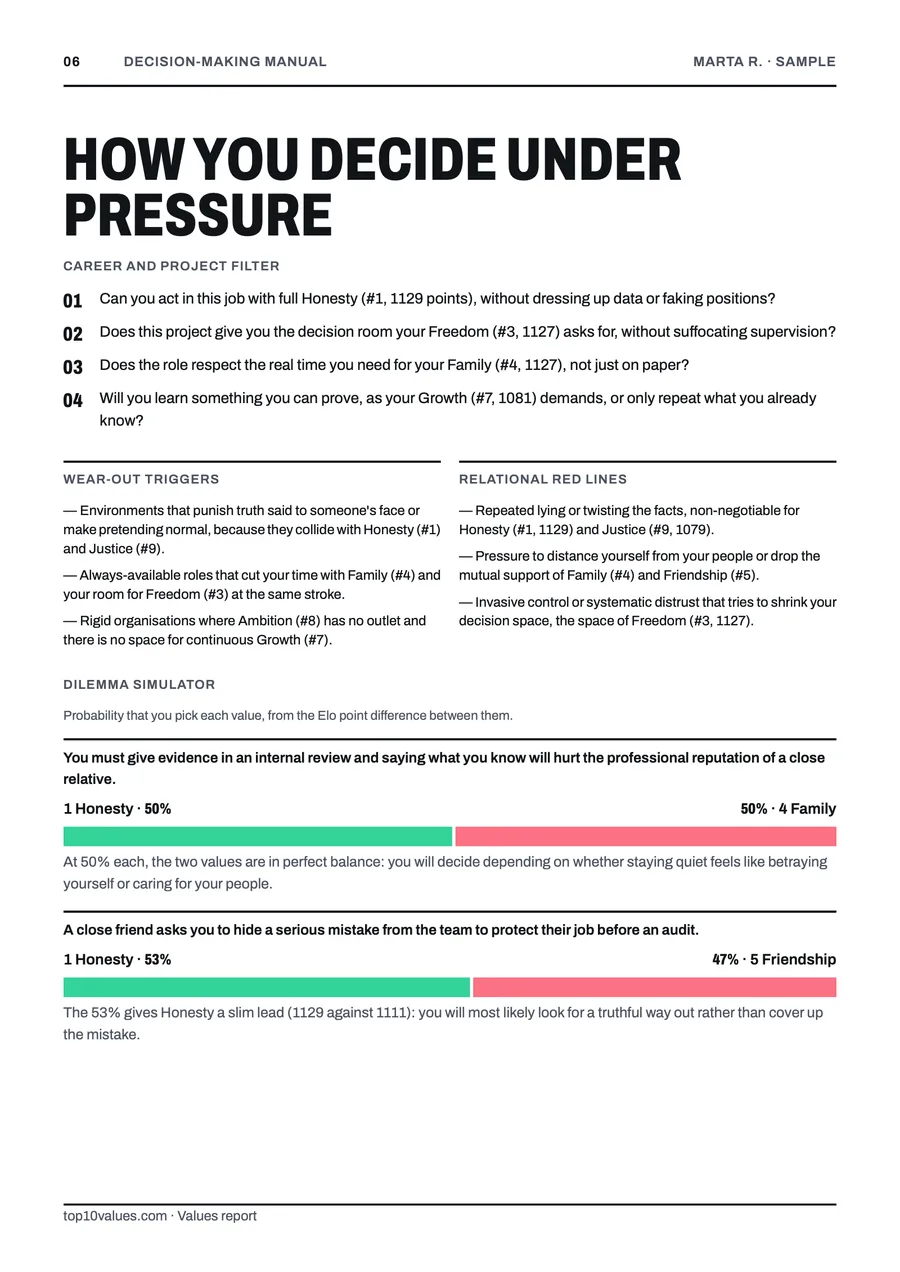
Sample page with fictional data (Marta R.), not yours. Your report is written from your own choices.
Frequently asked questions
What is vitality as a personal value, and how does it show in everyday life?
Valuing vitality means giving priority to living with energy and enthusiasm, and arranging your life so that energy reaches what matters to you. Everyday examples: saving difficult tasks for the time of day when you work best; taking a twenty-minute walk after lunch instead of scrolling; dropping a commitment that no longer makes sense and eats your Thursday evenings; suggesting a walk to a friend instead of another late dinner; going to bed early before an important day; or going back to the choir, the netball team or the allotment you gave up years ago. The common thread is that you do not treat your energy as something that just happens to you, but as something you can look after and direct.
What is the difference between vitality, health and happiness?
They are close, but not the same thing. Health is about your body and mind working well over the long term, and you look after it with habits and check-ups. Happiness is a broader judgement about your life and how satisfied it leaves you overall. Vitality is more immediate and more physical: the sense of having the energy and the appetite to throw yourself into what you are doing today. They can come apart. Some healthy people live with no spark, some people with an illness have plenty of vitality in their good hours, and some people feel happy with their lives during a low-energy period, such as the first months with a new baby. Looking after your vitality usually helps the other two, but does not replace them.
Can I value vitality if I'm a quiet or introverted person?
Yes, perhaps with even more reason. Vitality is not measured by volume, by the number of plans you make or by how lively you look to others. A quiet person can have a very steady energy that lets them read, work or care for others for hours without running out. What differs is where the energy comes from: many introverts recharge alone, in one-to-one conversations or in quiet activities, and are drained by long meetings and parties. Valuing vitality, in that case, means defending those recharging spaces without apologising for them, and not copying the energy model of someone who works differently.
Is it possible to have vitality with a chronic illness or in later life?
Yes, though it is lived differently. With a chronic illness or with age, the energy available is often lower or less predictable, and vitality becomes above all a matter of budgeting: deciding what each day's strength is spent on. In her 2003 essay The Spoon Theory, the writer Christine Miserandino popularised the image of “spoons” to explain how someone with a chronic illness starts each day with a limited number of units of energy and has to choose what to use them on; many people recognise themselves in it. At any age, vitality shows more in your interest in what is still to come than in the quantity of things you do: the eighty-year-old planning next spring's vegetable patch has more vitality than someone of thirty who no longer expects anything. If you notice a sharp drop in energy with no explanation, talk to your doctor before putting it down to age.
Why do I have no energy even though I sleep enough?
There can be many reasons, and some are medical, so if the tiredness lasts for weeks and rest does not improve it, the first step is to see your GP. Beyond that, there are leaks that sleep does not make up for. One is mental load: carrying around the list of everything that needs doing at home, at work and in the family uses energy even when you are sitting still. Another is lack of contrast: spending the whole day seated in front of screens, never changing scene or posture. Another is living far from what matters to you: a job that feels pointless or a tense relationship can drain you more than a short night. And another is having nothing to look forward to. The two-week energy map usually helps you see which of these weighs most in your case.
How do I get my vitality back after a period of exhaustion?
Slowly, and without turning it into another performance project. After a draining period, the temptation is to launch into an intensive plan (gym five days a week, new diet, early starts) that often wears you out further. Working in stages tends to go better. First, get your sleep back and remove what you can, even temporarily: a commitment, a meeting, an afternoon of errands. Then bring in a single activity you enjoy that has no goal attached, however small, and check your energy map to see whether it shows. Only later add challenges. If the exhaustion comes from work and does not ease, or if nothing has interested you for weeks, seek medical or psychological help. And before going back to your old pace, ask which part of that pace brought you here, because recovering without changing anything usually takes you straight back to where you started.
Does my energy affect the people around me?
In almost everyone's experience, yes. Walking in the door rushed and tense changes the mood of the evening meal, just as a keen colleague can lift a meeting that was heading for tedium. This cuts two ways. The good news is that looking after your vitality is not selfish: the people you live with benefit from you arriving with something left. The less comfortable part is that it is not your job to energise everyone, nor is anyone obliged to energise you. If someone close to you always lives without any enthusiasm, you can offer plans and company, but you cannot put your energy in place of theirs, and insisting on it usually leaves you both exhausted.
When Vitality clashes with…
Looking after your energy, versus achieving more, securing an income or throwing yourself into helping others.