Wellbeing
Health
Physical and mental wellbeing.

Health is the active prioritization of physical and mental wellbeing as the necessary foundation for enjoying and sustaining every other area of life. People who value health look after their diet, rest, physical activity and emotional balance consistently, understanding that without this base the rest of their achievements lose meaning or become unsustainable. This value can lead them to turn down job opportunities that demand excessive wear and tear, or to reorganize entire routines around self-care. Prioritizing health doesn't mean obsessing over the body, but recognizing that the physical and mental energy available directly determines the quality of everything else you do.
What does this value mean?
Health as a value means treating your body and mind as the foundation for everything else, and acting on that before a problem forces you to. It goes beyond not being ill: it covers enough sleep, regular movement, some thought about what you eat, booking the appointment when something feels off, and looking after your emotional state. It is a value of maintenance, built from small things done again and again.
It shows up in unglamorous choices. A nurse who finally gets her own blood pressure checked after years of looking after other people's, a delivery driver who stretches his back before every shift, a student who stops pulling all-nighters before exams because she has noticed how badly she thinks the next day, a man in his fifties who books the screening his doctor has mentioned twice, or someone who sees a counsellor because low mood has dragged on for months. It also appears in how you live through illness when it arrives: following the treatment plan, asking what you did not understand in the consultation, accepting help. For someone with a long-term condition, the value is not about being well but about living as fully as possible with what is there, without giving up the rest of what matters. The World Health Organization's founding constitution describes health as a state of physical, mental and social wellbeing and not merely the absence of disease, a broad definition that explains why this value reaches so far.
What it does NOT mean
Health is not a magazine-cover body or gym performance. Confusing health with appearance leads to crash diets, training through injuries, or reading your worth off a bathroom scale. Nor is it stocking the pantry with “wellness” products or following every trend: fixating on eating only perfect food can become a problem of its own, and if food or exercise brings you anxiety, it is worth talking to a professional. It is not the same as having no illness: people with serious diagnoses can live this value very consistently, while others with none ignore it entirely. And it is not a verdict on those who fall ill. Many conditions have nothing to do with what you did, and the thought that someone “brought it on themselves” mistakes looking after yourself for deserving a good outcome. Finally, it is not extreme caution: living afraid of everything is not being healthy either.
Related concepts
Why might it matter to you?
Raising children, doing good work, travelling, supporting your people and even enjoying a meal all depend on your body and mind cooperating. Health tends to be invisible while it works, which is why it gets put off. There is no deadline, until suddenly there is. People who rank it high have usually seen its absence up close, in their own illness, a relative's, or a burnout they did not see coming, and learned that neglect gets repaid with interest. It also protects independence: reaching seventy with strength, memory and mobility is not something you improvise at sixty-nine. That is a practical observation rather than a threat. Each small choice today (sleep, a check-up, a walk) protects your future freedom to do what matters to you.
Advertisement
How can you live this value?
- Rate sleep, movement and food from 1 to 10, as honestly as you can. Take the lowest and change just one thing for a month: a fixed time to switch off the lights, a ten-minute walk after supper, or a proper breakfast on weekdays.
- Take the overdue appointment off your someday list (dentist, eye test, health screening, blood work) and phone for a slot while you have the number in front of you. Waiting for a quiet week is the usual way of never going.
- Make movement independent of motivation. A weekly game with friends, a group run or a swim booked with a neighbour works better than promising yourself a run when you feel like it, because someone expecting you carries the routine through lazy days.
- Learn your early signs of overload before the crash: unusual irritability, recurring headaches, forgetfulness, flatness. When they show up, cut your load that week instead of gritting your teeth.
- Treat mental health with the same seriousness as physical health. Talking to someone you trust, limiting news that rattles you, or seeking professional help are not luxuries; they are maintenance.
- Set up your surroundings: fruit in sight, gym clothes laid out the night before, your phone charging outside the bedroom. On weak days, a well-arranged environment helps you more than willpower does.
What happens when you don't live up to this value?
When health is neglected, the bill arrives in instalments. First come the small signals: bad sleep, breathlessness on a flight of stairs, back pain accepted as normal. Then living at the limit becomes routine, with coffee to start and alcohol or screens to switch off, and choices are made through a fog. In the harder cases a scare arrives, a hospital stay or a diagnosis, bringing a sense of having come too late that can hurt more than the illness. People around you feel it as well: the partner worrying quietly, the children who see a parent worn out every evening, the colleagues covering your absences. And because the body warns in vague ways, many people discover they had been building up a debt for years without knowing it.
The healthy side and the shadow
When does this value stop helping you and start limiting you?
Healthy expression
Steady care without fixation
In excess
Obsessive control of the body
The excess is obsessive control: counting every calorie, monitoring every symptom, searching medical sites over and over, tracking sleep until the tracking keeps you awake. What began as care turns into anxiety, and life gets organised around the body rather than around what you want to do with it. Social rigidity can follow: being unable to enjoy dinner with friends because of a meal plan, lecturing others about their health, or judging anyone who does things differently. A useful signal: if looking after yourself brings more fear than wellbeing, or you blame yourself far out of proportion for one missed day, the value has stopped serving you. In that case, lean on a professional.
This value at work
At work, health is defended in ordinary habits: a lunch break taken away from your desk, standing up once an hour, using your annual leave, staying home with a fever rather than infecting the office to prove commitment, and refusing to make late-night replies the norm. It also shapes bigger choices. Night shifts, a long commute or an on-call rota carry a bodily cost, and anyone holding this value weighs that when comparing offers, not after signing. For people in physical trades such as building, care work or warehousing, it also means using the protective kit and reporting the unsafe ladder, even when that annoys someone. If you manage people, your example sets the bar: a boss who emails at eleven at night teaches the team that rest is optional. And a job with real physical or psychological hazards justifies asking for the protections you are entitled to.
This value in relationships
In friendships, health plays out in two ways. One is what you do together: walking, a casual game, cooking side by side, rather than always meeting over a drink. The other is how you show up when someone is ill. Often the most useful thing is bringing a meal round, offering to go along to an appointment with a frightened friend, or still calling after the first month, when the early wave of support has faded. When you are the one going through it, say what you need rather than hoping others will guess. And if a friend pushes you to drink, stay up late or skip your treatment “just this once”, you can say no without fuss. People who value you will understand.
This value in love
In a couple, health is shared whether you like it or not: your schedule, your mood and your energy all land on the other person. Practical agreements help, such as eating dinner at a decent hour, planning something active together, or respecting the other's sleep when one snores or rises early. Illness is delicate ground: when one partner falls sick, the other may drift into the role of carer, and that shift wears both down if it is never discussed. Talk early about how tasks are split, what is truly needed, and when to bring in outside help. Intimacy matters too: fragile mental health, chronic tiredness or some treatments can change desire, and speaking plainly protects the relationship better than silence. Do not turn into your partner's health inspector, though. People are encouraged more by example than by supervision.
This value in family
In the family, health begins with what children see at home: what lands on the table on a Wednesday, whether anyone says “I'm not coping” out loud, whether a trip to the doctor is routine or counts as admitting defeat. A father who keeps going to work with chest pain teaches something very different from one who calls the doctor. With children, habits they watch teach more than words: seeing you walk, sleep enough, talk about feelings or make an appointment. With ageing parents the other side appears: going along to check-ups, reviewing their medication, asking what they would want if their health worsens. These are awkward conversations best held while things are calm. For anyone caring for an ill relative, this value includes looking after yourself: carers who neglect themselves often burn out, and the person they care for loses a supporter. Asking for shifts, help or respite is not abandoning someone; it is holding things up.
This value and yourself
If health is among your core values, a recent experience may lie behind it (a diagnosis, an operation, a loss) or a conviction that the body is the base for everything else. Notice whether you live it as care or as fear: care shows in the calm with which you keep habits, fear in tension and the urge to check everything. Check also whether you apply the value to yourself or only to your looks: some people look after their bodies and neglect rest or their feelings. And if your health is limited today, the value does not disappear; it changes shape. It becomes the way you decide wisely where to spend your energy and how to accept help without feeling beaten.
What are you willing to sacrifice for this value?
Looking after your health has a price. Would you give up late nights out to sleep better? Would you decline a project you love if it meant weeks without rest? Would you change jobs if the present one is wearing you down, even if it paid more? Would you drop a habit you enjoy (smoking, staying up, certain excesses) knowing the payoff arrives years later? There is a social cost too: being the one who suggests another restaurant, leaves early, or skips the toast, sometimes to a few remarks. And it demands time: doctor visits, exercise and cooking take hours you could spend on something more rewarding in the moment. Better to decide yourself what you will trim today (late nights, extra hours, postponed appointments) than to let an emergency decide for you.
Signs you're betraying this value
This value is lost through exceptions nobody writes down: you say your health comes first and have gone a year without a check-up, you sleep five hours for weeks and call it “my rhythm”, or you self-medicate to keep performing rather than asking what is wrong. It is also lost when you ignore a symptom because you fear what it might be, or when you turn care into punishment (training out of guilt, eating by counting). And when you use health as an excuse to avoid what scares you, such as not going out, not trying, not seeing people. The most reliable signal is a gap between what you promise and what you do in an ordinary week: open your calendar and look at how much room your wellbeing actually has.
Turning the value into goals
Value
Health
Behavior
Go to bed at the same time five nights a week, walk twenty minutes a day and book this week the medical appointments you have been postponing
Goal
Within three months, have completed the overdue check-ups and settled into two hours of weekly movement and a fixed bedtime on most nights
Habit
Every night, write one sentence on how you slept and felt, and on Sunday look for the pattern that repeats
Questions to reflect on
- When did you last feel properly energetic, and what was different in your life then?
- Which appointment, check-up or conversation about your health have you been postponing, and what holds you back?
- Which habit would you change if you knew your sixty-year-old self would thank you for it?
- Do you look after yourself out of wellbeing or out of fear, and how does your body show the difference?
- Which of the commitments you take on cost you rest, and which could you drop?
- If you had to explain to a friend how you look after your mental health, what would you say?
How much are you living this value?
From 1 to 10, how closely does your usual week resemble that of someone who values their health? Go back over the last seven days: how many nights you slept as much as you need, how many days you moved, and which appointment is still pending. If the score is below six, choose one habit to improve for two weeks and note how your energy and mood respond. If something genuinely worries you, have a professional take a look.
When two values clash
Health clashes with Ambition and Success when a goal demands long days, constant travel or trimmed sleep: the promotion that costs you your back or your mood. With Adventure the clash is about risk: climbing, solo trips to remote places or extreme sports give life meaning but accept dangers that caution would advise against. With Freedom it appears when you want to decide about your body, diet or excesses without anyone telling you what to do. With Family and Service the conflict is time: caring for others leaves little room for you, and exhaustion eventually affects everyone. With Financial security there is a harsh tension: sometimes working more is the only way to pay the mortgage, and health pays the instalment. A useful guide is to ask what you would change for your health and what you would not, before your body decides for you.
Is “Health” one of your top 10 values?
Find out by playing and comparing this value with the other 49
How the Elo ranking works and its limits in the methodology.
What does the paid report include?
When you finish the 100 comparisons you will see your Top 10 on screen. If you want to go further, there is a PDF report on your personal values: €9.95 (VAT included), one-off payment. To buy it you need to save your game with a Google account.
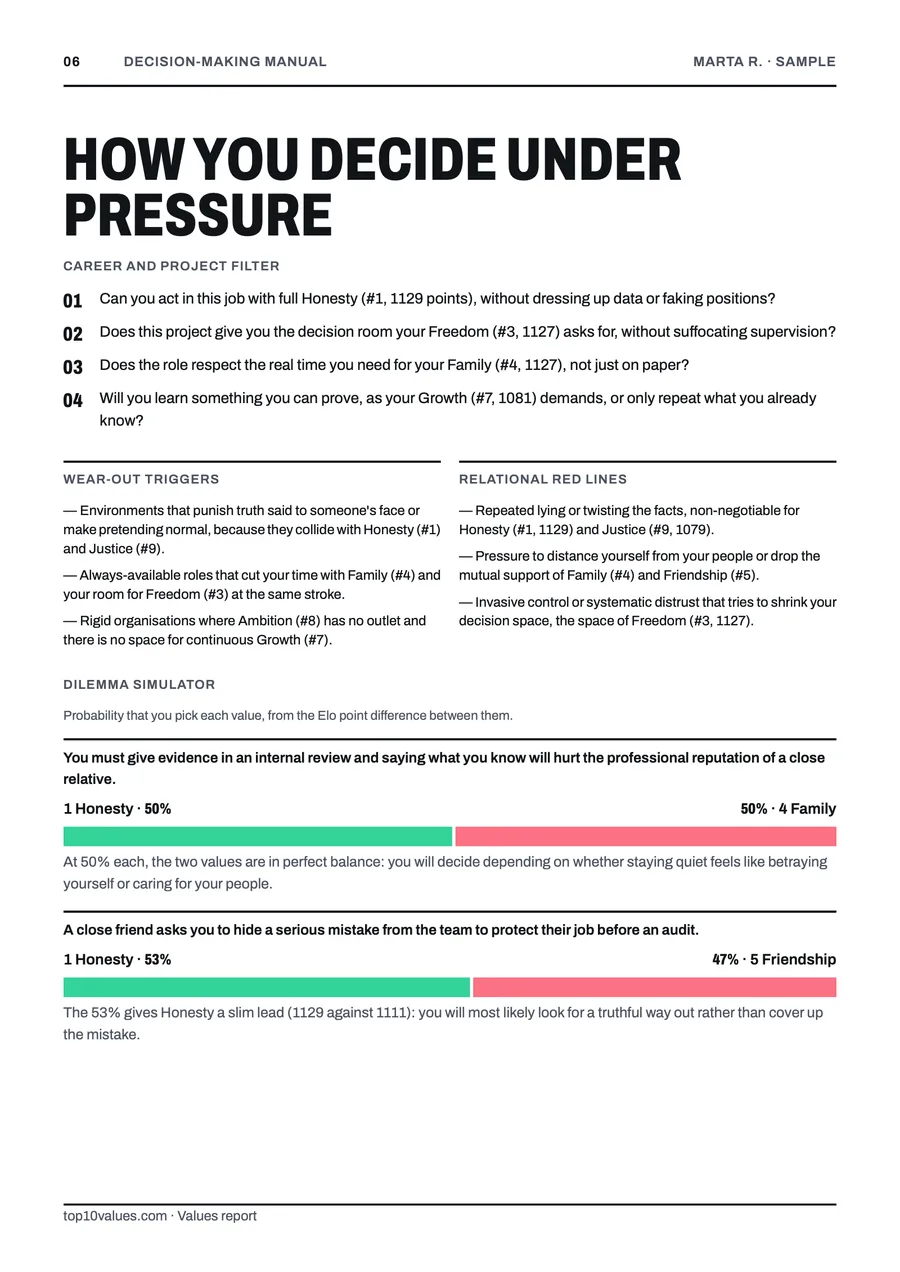
Sample page with fictional data (Marta R.), not yours. Your report is written from your own choices.
Frequently asked questions
What is the difference between valuing health and being obsessed with it?
Care gives you calm and freedom; obsession gives you anxiety and rules. Someone who values health allows a celebratory dinner or a rest day without guilt. If looking after yourself stops you enjoying things, isolates you or leaves you anxious, talk to a mental health professional, because there may be more behind it than a habit.
Where do I start if I have many habits to change?
With one. Sleep is often a good candidate because it affects mood, appetite and the energy to move. Choose a specific behaviour (a bedtime, a walk after lunch) and keep it for a month before adding another. Changing everything at once tends to end in giving up.
Is mental health part of this value?
Yes, and with the same weight as physical health. Watching your mood, rest, relationships and stress level is part of the care. If you notice persistent sadness, anxiety that overwhelms you or loss of interest lasting weeks, talking to your doctor or a therapist is a way of applying this value, not of failing at it.
Can I value health if I have a chronic condition?
Of course. The value does not require being well, only acting consistently: following the treatment, adjusting your pace, asking for support, asking questions at appointments. Some people with a long-term condition apply this value more clearly than some with none, because they know what it costs.
How do I balance health with a demanding job?
Start by protecting the bare minimum: a block of sleep and a real break to eat. Then identify which parts of the load are negotiable (deadlines, meetings, availability after hours) and raise them with facts. If the job still wears you down steadily, considering a change is reasonable, since no salary makes up for damage you cannot reverse.
When Health clashes with…
Invented scene. Óscar founded an app and has the launch fixed for two weeks from now. He has had migraines for a month, and his doctor has told him to stop for a few days and sleep. Ambition whispers that a launch window does not come back. Success puts two investors on the table who are waiting for results. Freedom plays on both sides: it is his body and his risk, but it is also the thing he would lose if he ended up tied to a long sick leave. Health is not asking for heroics or for retirement; it asks that the cost stop being invisible. It helps to ask which part of the launch only he can do, what he can hand over, and what concrete sign (another episode, a week without sleep) would make him really slow down. A method for deciding is in conflicting values.