Wellbeing
Happiness
Feeling of joy.

Happiness, understood as general subjective wellbeing, is the pursuit of a predominantly positive and satisfying emotional state in everyday life. People who prioritize happiness evaluate their decisions not only by their logic or productivity, but by how much they contribute to feeling good in a sustained way. This can lead them to turn down well-paid but draining jobs, or to prioritize activities that bring joy even if they add no status. Unlike momentary enjoyment, happiness as a value seeks a stable trend of positive mood over time, integrating both small everyday pleasures and satisfaction with the overall direction of life.
What does this value mean?
Happiness as a core value means deliberately shaping your life so that it holds real enjoyment, meaning and good company, and treating your own wellbeing as something you tend week by week rather than a reward that arrives once everything else is done.
It stands for the belief that living well is not a luxury to be postponed until the mortgage is paid, the children have grown up or the promotion has come through. You can see it in ordinary choices: accepting a slightly lower salary so you can leave at half past five and eat with your family; keeping Saturday morning for the market, a flat white and a walk with your phone left at home; moving to a smaller flat ten minutes from your friends instead of a bigger one an hour away; dropping a hobby that has turned into a chore and picking up one that makes you laugh. It also shows in attention: noticing the smell of fresh bread, or properly celebrating a pass mark or a piece of good news instead of moving straight on to the next task. Greek philosophers have argued for centuries about what a good life is. Aristotle spoke of eudaimonia, often translated as «flourishing», which is not the same as being in a good mood but means living well in the fullest sense. People who choose this value often ask themselves: is what I am doing right now doing me good, or just keeping me busy?
What it does NOT mean
It does not mean being cheerful all the time. Someone who values happiness still cries at funerals, gets angry about injustice and has weeks of exhaustion; what sets them apart is that they do not treat those moments as failure but as part of the road. Nor is it compulsory positivity: telling someone who has just been made redundant to «look on the bright side» is not happiness, it is denial. It is not the same as pleasure either: a biscuit, a box set or an impulse purchase gives a pleasant half hour and, repeated as your only strategy, tends to leave a hollow feeling. It is not selfishness, although it is sometimes accused of that: a life with some joy in it often sustains generosity, because it is hard to give from exhaustion. And it is not the same as owning things or having everything go to plan: some people with little money live lightly, and some with everything sorted wake each morning with a knot in the stomach.
Related concepts
Why might it matter to you?
Most people say they want to be happy, yet few write it down among their concrete priorities: it stays a vague wish that depends on luck. Making it a value changes something practical, because it makes you compare each decision with a question hardly anyone asks: does this move me towards a life I want to live? Changing jobs, accepting a relocation, committing to a project or filling the diary with social plans all weigh differently when the test is not only «what is sensible» but «what will be good for me over the years». Happiness is not purely private, either: the mood you bring home, the patience you have with a child and the way you answer a colleague all depend in part on how you are. Behind this value there is often an experience that woke it up: an illness, a loss, or a stretch of work so intense that one day you asked yourself what it was all for.
Advertisement
How can you live this value?
- Write down five moments from the past few months when you felt genuinely well, then look for what they share. Perhaps all of them involved other people, or being outdoors, or finishing something with your hands. That concrete list tells you more about your own happiness than any general definition, and lets you schedule more of it instead of waiting for it to happen.
- Put a weekly block in the diary that is not up for negotiation: lunch with a friend, a long walk, the pottery class. Treat it with the seriousness of a meeting. What is not in the calendar usually loses to whatever is urgent.
- At the end of each day, jot down one thing that went well, however small. The aim is not to force optimism but to train your attention so that it does not register only what goes wrong. If one day you find nothing, write that down too and notice what was going on.
- Pick one habit that drains you and gives nothing back, such as endless scrolling before bed or saying yes to plans you dread, and drop it for two weeks. Watch what fills the gap and how you feel.
- Celebrate achievements before moving on to the next. When you finish a hard report, pass an exam or complete a race, give yourself an hour to enjoy it: a meal, a phone call to whoever backed you, a walk. If you always leap to the next target, happiness stays parked in a future that never arrives.
What happens when you don't live up to this value?
When you neglect this value, life turns into a string of tasks ticked off without being tasted. The signs are discreet: you wait for Friday from Monday, you spend the holiday thinking about going back, you answer «fine, busy» to any question about how you are. You struggle to remember the last time you laughed out loud or did something purely because you wanted to. Envy of people who seem to enjoy themselves appears too, and it is often a clue to what you miss. In time the tiredness hardens into cynicism («that's just how it is») and the people around you notice: they invite you out less because they assume you will say no. If happiness is among your main values, that colourless routine is felt as an uncomfortable gap between what you say you want and how your weeks actually go.
The healthy side and the shadow
When does this value stop helping you and start limiting you?
Healthy expression
Joy that sits alongside sadness
In excess
Forced positivity and running from discomfort
The shadow of happiness appears when you turn it into an obligation: you must be fine, you must look fine, and anything that hurts gets hidden. You change the subject when a friend talks about their grief, answer with a stock phrase («everything happens for a reason») to someone who needs to be heard, or fill the diary with plans so you are never alone with a worry. People who run like this pile up what they avoid, and tend to blow up over small things. Another version is escapist hedonism: shopping, eating, drinking or bingeing television without pause, hoping the pleasant moment will cover the rest. To see which side you are on, ask three questions. Can I be sad without feeling guilty? Can I bear a close friend being unwell without rushing to fix it? Does what I do for enjoyment leave me better the next day, or worse? If the last answer is usually «worse», you may be using pleasure as an anaesthetic.
This value at work
At work, valuing happiness means asking whether your days give you energy or take it away, and acting on the answer. It might be asking for a compressed week so you can collect the children on Fridays, negotiating hours that let you reach an evening dance class, turning down a weekly meeting that could have been an email, or declining a prestigious project that would eat your weekends for six months. It also means caring about the atmosphere you create: a team that marks the end of a project, where someone brings cake on a birthday, tends to work better than one that only talks about deadlines. Beware of the opposite extreme: confusing happiness with avoiding every awkward task. Every job has dull stretches, and a job that makes you happy is not one without effort. The useful question is not «do I enjoy it all the time?» but «is there enough in my week of what fills me to balance what weighs on me?». If the answer stays no for months, it is worth working out whether the problem is the task, the setting, the manager or you.
This value in relationships
In friendship, this value shows in whether you spend time with people who make you feel light. Some friendships leave you wanting more; others leave you worn out from listening to complaints or justifying yourself. Checking from time to time how you feel after each meeting gives you valuable information. That does not mean dropping someone going through a bad patch: standing by a friend through a divorce is part of friendship and does not reduce joy in the long run. What is worth watching is the proportion: if most of your relationships only ask things of you and almost none feed you, something needs to shift. Taking the initiative helps a great deal: instead of waiting for someone else to organise, be the one who calls the supper, the day out or the Sunday five-a-side. And share good news with people who are truly glad for you, not only with those who listen out of duty.
This value in love
In a couple, happiness asks for more than the absence of conflict. A relationship can be calm and still flat: two people who run the household logistics and have not laughed together for months. Looking after it means setting aside time for what amused you at the start: the aimless walk, the supper without phones, the in-joke only the two of you understand. It also means talking about what each of you needs to feel well, because what fills you may differ: one person is recharged by seeing people, the other by a Sunday at home. A common mistake is depending on your partner for all your joy, as if making you happy were their job. That wears them out and leaves you vulnerable: a healthy partnership adds to a life that already has friends, interests and projects of its own. And when one of you goes through a rough patch, shared happiness means keeping them company without insisting they pretend to be fine.
This value in family
In the family, this value is tested between duty and enjoyment. Some Sunday roasts, school-run juggling acts and weekly calls to your parents feel like a chore, while others are looked forward to; the difference often lies in how they are arranged. You can suggest simple changes: a family quiz or a shared recipe at Christmas instead of the usual conversations on repeat, a rota so one person is not stuck in the kitchen all afternoon, or a weekly ritual with your children, such as Saturday pancakes or a muddy walk before the match, that they can count on. With children, happiness is also passed on by what they see: if they hear you always complaining about work and Mondays, they learn that living means putting up with things. That does not call for pretending; you can say «I'm tired today» and also «I really enjoyed that». With older parents, it helps to remember that their wellbeing often has simple ingredients: an unhurried visit, a meal they like, or patiently listening to a story you have heard before.
This value and yourself
Choosing happiness as a main value suggests you care about the quality of your everyday life and not only its results. You probably notice early when something drains you, and find it hard to stay in grey surroundings for long. It may also mean you have been through a period when you put off enjoyment and do not want to repeat it. It is worth checking whether you treat happiness as a goal to reach or as a daily practice: the first version breeds anxiety («why am I not happier?») and the second leads to concrete decisions.
What are you willing to sacrifice for this value?
Choosing happiness costs visible things: a bigger salary that does not repay the hours, a promotion that would take you away from your city, a circle of friends you drift from because it no longer does you good. Would you leave a secure, well-paid job that wears you out for one with less money and more room to breathe? Would you turn down an important invitation rather than fake a joy you do not feel? And the other way round: what immediate pleasure would you give up for something that will do you good in a few years, such as a master's degree or a season of saving? This is not a value of instant gratification. Sometimes living it means giving up today's pleasure because you know it will leave you worse off tomorrow.
Signs you're betraying this value
You are betraying this value when you have spent years saying «once this is over I'll look after myself» and the «this» is always something new. Also when you accept social plans out of obligation that leave you drained and repeat them every month, when you spend your holidays answering emails, or when you cannot remember the last time you did something purely for the pleasure of it. Another sign is constant comparison: looking at other people's profiles and feeling your life falls short, instead of asking what you would like. And a less visible one: using irony and «I'm not really into that sort of thing» so you never have to admit you fancy something, like dancing, travelling alone or joining a painting class.
Turning the value into goals
Value
Happiness
Behavior
Set aside a fixed block of time each week for something you do only because you like it
Goal
Over the next three months, try two new activities and keep the one that leaves you with more energy afterwards
Habit
Each evening, note one thing from the day that lifted your mood, however small, and read the list back on Sunday
Questions to reflect on
- Which activity that made you happy five years ago have you dropped without ever deciding to?
- How many years of your life are propped up on sentences that begin «when I get this, I'll be happy»?
- After seeing which person do you come away lighter, and after which one more tired, and what do you do with that information?
- Which pleasure do you use today so you do not have to feel something you would rather not look at?
- What would you say if a friend described your week exactly as you live it and asked whether it sounded like a life worth having?
- How much of your happiness depends on a single person or a single job, and what would happen if it were gone?
How much are you living this value?
Out of 10, how much of what you do in an ordinary week do you do because it gladdens you, and not only because it has to be done? To answer, go back over your last seven days and count the moments you chose purely for pleasure. If your score is below 6, take an activity from your list of the five best moments of the past year and put it in this week's diary.
When two values clash
Happiness clashes with Ambition when the road to a goal demands years of sacrifice: is a promotion worth it if it takes your evenings? With Discipline, because almost any achievement asks you to do things today you do not feel like, and with Growth, which often involves deliberate discomfort. With Honesty, if you say a truth that spoils a pleasant atmosphere or refuse to pretend all is well. With Family and duty, when what is expected of you differs from what makes you happy: caring for a sick relative, keeping an inherited business going. And with Justice, because enjoying yourself while people nearby suffer can bring guilt. It fits well with Gratitude, which makes you notice what you already have, with Inner peace, which steadies joy, and with Health, because sleeping, moving and eating well support almost everything else. It helps to remember that happiness is not a value that always wins: sometimes you pick another and do it on purpose, knowing what it costs.
Is “Happiness” one of your top 10 values?
Find out by playing and comparing this value with the other 49
How the Elo ranking works and its limits in the methodology.
What does the paid report include?
When you finish the 100 comparisons you will see your Top 10 on screen. If you want to go further, there is a PDF report on your personal values: €9.95 (VAT included), one-off payment. To buy it you need to save your game with a Google account.
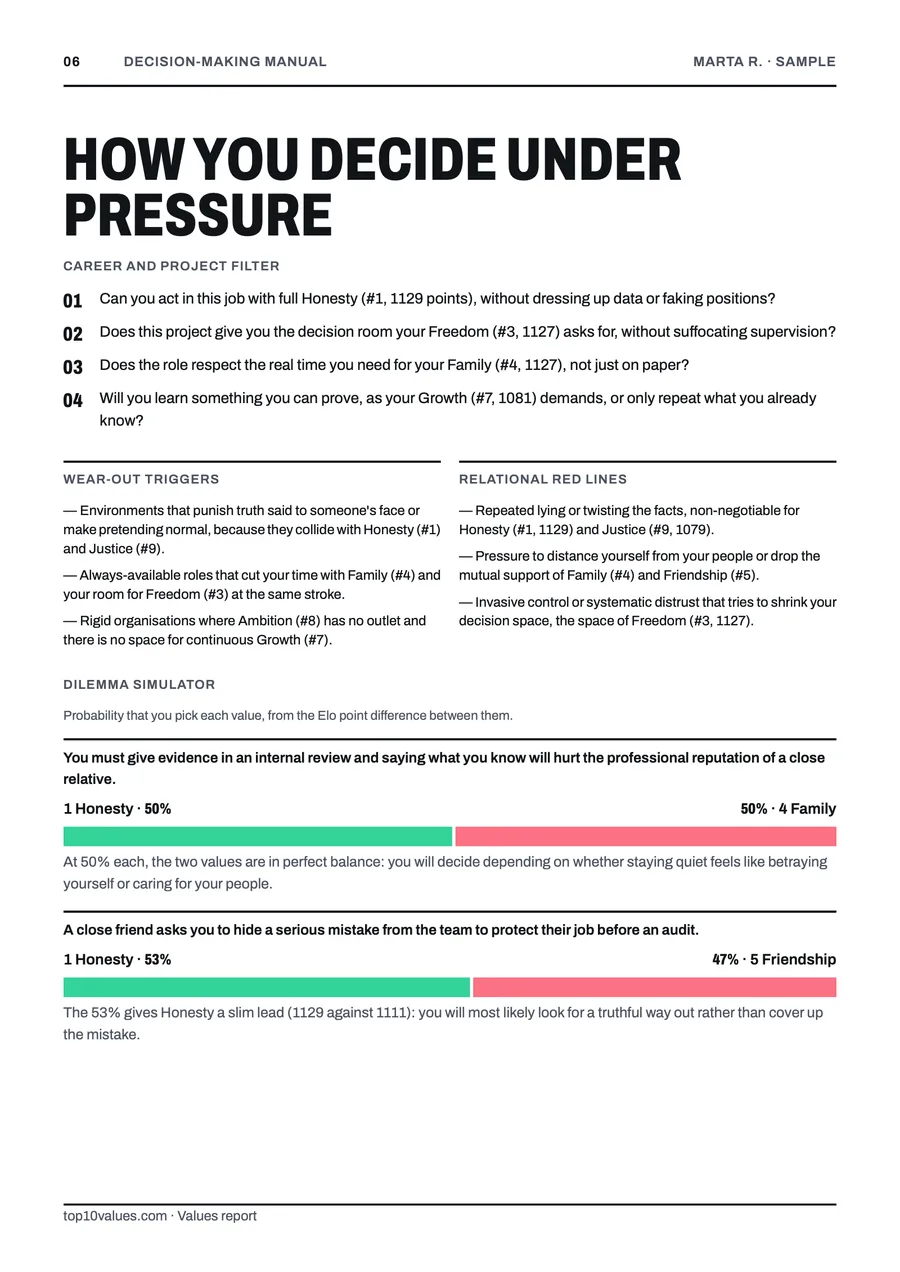
Sample page with fictional data (Marta R.), not yours. Your report is written from your own choices.
Frequently asked questions
Is it selfish to put happiness among my main values?
Not necessarily. It is selfish when you turn your wellbeing into an excuse for answering to nobody. But looking after your joy usually improves what you offer: you have more patience, more humour and more energy to help. One way to check is to see whether the choices you make to feel well harm other people directly or, on the contrary, benefit them.
What is the difference between being happy and being pleased?
Being pleased is usually passing: good news, a sunny day, supper with friends. Happiness as a value is broader: it concerns whether your life as a whole has meaning and enjoyment. You can have a bad day and still feel you are living well, or have a wonderful day and suspect something important is off. Aristotle distinguished precisely between momentary pleasure and a life well lived.
What if I do not know what makes me happy?
Start by observing rather than thinking. For two weeks, note at the end of each day which moment gave you the most energy and which drained it. After that you will see patterns: people, places, kinds of task. Then try new things in a small way, such as a taster class or a day trip, before committing to anything big. If the feeling of emptiness is persistent and stops you functioning, it is worth talking to a health professional.
Can you be happy in a job you do not like?
Yes, if the rest of your life fills you and the job does not consume you. Many people separate what they do to earn a living from what gives them meaning: they put that into family, sport, music or volunteering. The problem comes when work leaves you with no energy for anything else. In that case it is worth considering changes, even gradual ones, such as fewer hours, a different team or slowly preparing an exit.
How do I stop comparing myself with other people's apparent happiness?
Remember that you are seeing other people's best moments and your own whole week. Cut back the time spent on feeds that leave you worse off and replace it with direct contact with people who matter to you. When you feel envy, ask which specific part of that person's life you want: the trip, the flexible hours, the partner. That answer points to something real that you miss and can begin to build.
When Happiness clashes with…
Invented scene. Monday, 5:40 pm. Marina goes over the sheet where she tracks her savings for a flat deposit and sees that this month she skipped dinner with her friends to stay within budget. She has done this for two years and each month it looks reasonable. Happiness does not ask her to drop the plan, only to ask whether in five years she will remember the dinner or the figure. Ambition replies that the flat is the security she truly wants and that a small sacrifice today buys a bigger life later. Discipline knows that if saving depends on the mood of each Monday, it never happens. Justice adds an uncomfortable angle: her brother cannot save anything and she feels guilty spending on leisure. It may help to set a leisure budget that is as untouchable as the savings, and to check after six months whether the plan is still hers. More scenes in conflicting values.