Relationships
Friendship
Close supportive relationships.

Friendship is the voluntary bond of affection, trust and mutual support built over time, which doesn't depend on family ties or formal obligations. For people who prioritize this value, having a small circle of people with whom to share joys, doubts and hard moments is as important as any professional achievement. Friendship offers a network of emotional support, an outside perspective on important decisions, and a space where you can be yourself without masks. Unlike other relationships, it is sustained by ongoing choice: it is cultivated through presence, honesty and reciprocity, not through convenience or geographic proximity.
What does this value mean?
Friendship as a value means giving priority to the bonds you choose freely, built on trust, affection and mutual support, and giving them time and attention even though no blood tie, contract or habit forces you to.
It stands for the idea that the people you choose matter as much as the ones you were born with. People who put friendship first look after their circle consistently: they remember that Thursday was the job interview, turn up with a bag of groceries when someone is moving house, and ask again about the thing that was left unresolved. They know a friendship does not sustain itself just because you met at school: it stays alive by decision, and that decision is renewed every few weeks through small gestures. It is a value of choice and reciprocity. Nobody requires you to be someone's friend, so every call, visit and favour is voluntary, and that is why they mean so much.
What it does NOT mean
It does not mean having lots of friends or being available to everyone at any hour. A diary full of plans is not the same as a circle of trust. Nor does it mean agreeing with them on everything: a good friend is the one who tells you that you are about to make a mistake, and says it in a way you can hear. It is not blind loyalty either: supporting someone is not the same as covering for them when they hurt other people. Finally, friendship is not measured in years. There are people you have known since childhood with whom you now share only memories, and others who arrived two years ago and know more about you than anyone.
Related concepts
Why might it matter to you?
Friends are the network that holds you when everything changes: a break-up, a move to another city, a lost job, an illness in the family. They offer something neither a partner nor family can fully give: an outside view that knows you well, does not depend on you financially or legally, and is not caught up in the conflicts at home. With a friend you can say out loud what you do not dare tell your partner or your parents, and test it before you decide. They are also the ones who remind you who you were before certain jobs or certain relationships, and who are glad about your good news without anything changing for them. Valuing friendship means investing in that network before you need it, because a friend you only call in a crisis tends to feel more like a resource than a person. It asks for something that is hard to find in adult life: time without an objective, meeting up for no reason beyond being together.
How can you live this value?
- Take the initiative and attach a date to it: "are you free Thursday at eight?" works better than "we should catch up sometime". Adult friendships rarely end in a fight; they cool down because nobody suggested anything for too long.
- Remember what they told you last time, whether an interview, a medical test or a difficult conversation with their boss, and message them a few days later to ask how it went. It is the cheapest gesture and the one people appreciate most.
- Celebrate your friends' wins with the same energy you bring to supporting them when things go badly. Supporting someone through the bad times is easier, because you feel useful; being truly glad about a promotion or a new home means putting comparison aside.
- When something about a friend bothers you, say so early and in private, without an audience and without sarcasm: "you cancelled twice in a row the other day and it hurt". A small complaint made in time prevents the resentment that turns into distance.
- Keep some ritual that does not depend on having news to share: Saturday coffee, the call on the way home, the monthly dinner even if it is just pizza. Rituals carry a friendship through the periods when neither of you has the energy to organise anything.
- Introduce your friends to each other and mix your circles from time to time. Groups that know each other create more chances to meet and do not depend only on you as the point of connection.
- Show up in practical ways without being asked: bring food to someone who has just had a baby, help with a move, offer your car for a trip to the hospital. Many people find it hard to ask for help, and the friend who steps in first saves them that step.
Advertisement
What happens when you don't live up to this value?
When you do not live this value, friendships shrink little by little into a group chat, a "we must meet up" that never gets scheduled, and birthday messages. There is no break-up, which makes it hard to notice: one day something serious happens, you look at your phone and cannot think of anyone you could call without feeling you are intruding. Or you discover that it has been years since you saw the person you considered your best friend, and that you heard about their wedding on social media. Over time your social life gets organised around your partner, your colleagues or the families of your partner's friends, and when those structures change, you are left without a network. Another common sign is loneliness in a crowd: you go to dinners, meetings and celebrations, but nobody knows how you really are.
The healthy side and the shadow
When does this value stop helping you and start limiting you?
Healthy expression
Loyalty with judgement
In excess
Going along with the group
Friendship becomes a problem when the need to belong outweighs your own judgement. It shows up as covering for a friend who is hurting someone else, keeping an opinion to yourself so as not to spoil the mood, laughing at jokes that make you uncomfortable, accepting plans you do not want out of fear of being left out, or neglecting your partner, your work and your rest in order to be always available. There is also a subtler version: holding on at all costs to a group of friends who no longer share anything with you, because you fear that without it you would have no one. The line is whether the friendship lets you be yourself or asks you to trim yourself to fit. A healthy friendship can handle you saying no, disagreeing and disappearing for a while without breaking.
This value at work
You make friends at work easily, and that creates a good atmosphere and teams that look out for each other. But it also complicates concrete decisions: giving a poor review to someone you have drinks with, competing for the same role as a close colleague, or reporting a mistake that could harm a friend. It helps to be clear about where the colleague ends and the friend begins, and to give notice when a professional decision may strain the personal relationship: "I'm going to have to say this in the meeting, and I'd rather you heard it from me first". Another risk is that your whole social life depends on work: if you change company or are laid off, you lose half your circle in a month. That is why it is worth keeping at least one friendship that has nothing to do with your job.
This value in relationships
Your circle is a central part of your identity, and you probably keep friendships from different stages: school, university, a trip, an old job, a neighbourhood you no longer live in. For you, meeting someone new is also the chance of a lasting friendship, which is why you take an interest in people beyond polite conversation. Watch out, though, for the usual imbalance: giving a lot to people who give little can end in resentment. Not all friendships have to be alike; there are lifelong ones, ones built around a shared hobby, ones that exist only online, and ones tied to a particular period. Recognising what place each one has stops you asking a friendship for what it cannot give, and lets you appreciate what it does.
This value in love
In a couple, you need room for your friendships, and for your partner not to experience it as a threat or as stolen time. For you, an evening with friends does not take away from the relationship, it feeds it. Often your partner ends up being your best friend too, which is a strength as long as they do not replace the rest of your circle: when your whole emotional life rests on one person, any crisis in the relationship leaves you without a network at the worst moment. At the start of a relationship the risk is vanishing for months from your friends' lives; they remember it, and the friendship suffers. And when someone in your circle and your partner do not get along, you have to hold both bonds without forcing either to pretend.
This value in family
In your family you tend to look for closeness as well as kinship: siblings or cousins who are also friends, with whom you can laugh and speak without a filter. When family falls short, friends often become your chosen family: the ones who keep you company at Christmas if you cannot travel, who look after you after an operation. That does not displace your relatives, but it reminds you that affection does not depend on a surname. One risk is worth watching: spending so much time with friends that your parents or siblings get the leftovers, or the reverse, family duty eating all your free time and leaving your friendships with no room. With children, friendship teaches without a lecture: they see how you look after your people and learn what a reciprocal bond is.
This value and yourself
Having friendship among your priorities says that you believe in chosen bonds and in reciprocity, and that you measure your life partly by the people you share it with. You are probably the one who keeps a group together, who organises the dinner, who writes when someone has gone months without a sign. Ask yourself whether you do it out of affection or out of fear that if you stopped, nobody would look for you: the difference matters, because in the second case you will wear yourself out and feel you give more than you receive. You may also find it hard to ask your friends for help, even though you would go without hesitation if they were the ones in need. Letting yourself be looked after is part of friendship.
What are you willing to sacrifice for this value?
Would you drop a plan you were looking forward to in order to be with a friend going through a bad time? Would you travel to another city for their wedding or their farewell, even if it costs you money and holiday days? Think of the last time you did, and how you remember it. If it came naturally and you would do it again, the value is solid. If you felt used, that nobody was grateful, or that the friend would never do the same for you, some friendships may be less reciprocal than you think. And look at the opposite sacrifice too: what have you left unsaid to keep the peace in the group? Keeping quiet about an important opinion or accepting a plan you did not want is not an act of friendship, even if it looks like one.
Signs you're betraying this value
You go against this value when you only call your friends if you need something, when you discuss their problems with other people or speak badly of them behind their backs, or when you vanish as soon as you start a new relationship or job and return only when it ends. Also when you are absent at the moments that matter (an illness, a bereavement, a move) and then justify yourself with your schedule. A smaller but frequent betrayal is cancelling plans at the last minute again and again, or arriving at get-togethers glued to your phone. And so is keeping out of habit friendships that no longer give you anything without saying so, because you leave the other person waiting for something you are not going to give. Ending a friendship honestly is more respectful than letting it die through silence.
Turning the value into goals
Value
Friendship
Behavior
Take the initiative to see your friends and tell them what matters to you, without waiting for them to go first
Goal
This quarter, meet up in person with a friend you have not seen for over a year
Habit
Suggest a concrete plan, with a day and a time, to someone in your circle every week
Questions to reflect on
- If you had an emergency tomorrow, whom would you call first, and when did you last speak to that person?
- Which friendship is cooling down only for lack of initiative, and what concrete plan could you suggest this week?
- Are you usually the one who calls or the one who waits to be called? How does the other side experience it?
- Is there a friendship you keep out of habit rather than affection?
- Which friend knows how you really are, not the polite "fine, and you?"
- Is there a friendship in which you still owe something you have been holding back for a long time?
How much are you living this value?
From 1 to 10, how well do you actually look after your friendships compared with how important they are to you? If the score is low, write today to someone you haven't spoken to in a while and suggest a day to meet. Keep it short and free of long apologies: "I thought of you, shall we have a coffee on Thursday?".
When two values clash
Friendship sometimes clashes with Honesty: do you tell a friend you do not like their partner, that they are drinking too much, or that they are making a mistake with their business? Staying quiet protects the moment but can cost trust later; saying it badly can end the relationship. It usually helps to ask first whether they want your opinion and to speak from what you have seen, not from judgement. It also strains against Ambition and Success, when work or competition leaves little time for the group, or when a promotion pulls you away from those who remain where you were. With Loyalty the tension is different: backing a friend when they are wrong is not the same as justifying what they have done. And with Love and Family the difficulty is how to share your time, because not everything fits and someone feels they get less. It helps to remember that a strong friendship can handle a truth told with care, a cancelled plan announced in advance, and a season of silence.
Is “Friendship” one of your top 10 values?
Find out by playing and comparing this value with the other 49
How the Elo ranking works and its limits in the methodology.
What does the paid report include?
When you finish the 100 comparisons you will see your Top 10 on screen. If you want to go further, there is a PDF report on your personal values: €9.95 (VAT included), one-off payment. To buy it you need to save your game with a Google account.
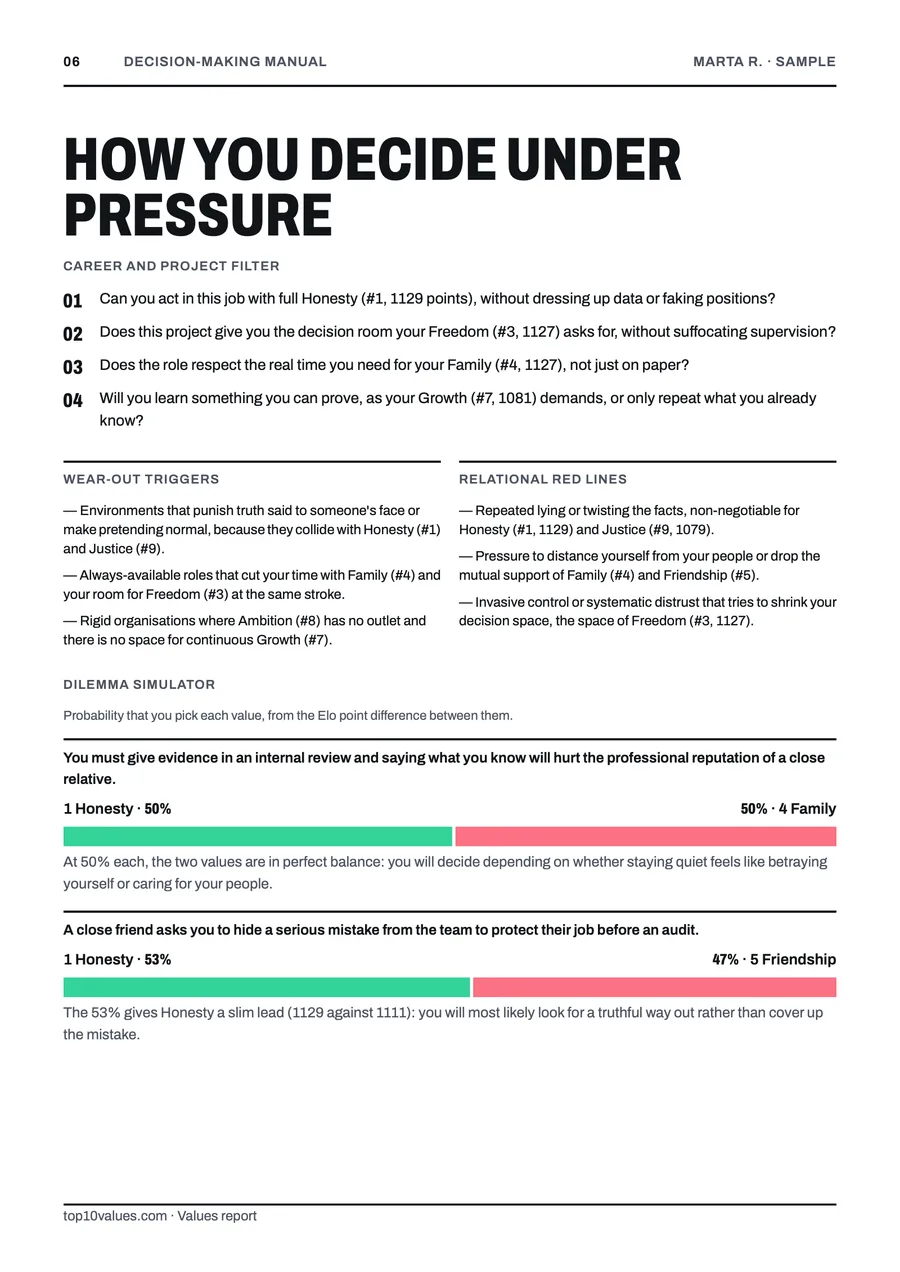
Sample page with fictional data (Marta R.), not yours. Your report is written from your own choices.
Frequently asked questions
Is it normal to have fewer friends as an adult?
Yes. With work, a partner or children there is less time and fewer chances to cross paths, and you no longer have the classroom or playground that put you with the same people every day. Adult friendships tend to be fewer and need more initiative, but they can be deeper precisely because they are chosen more consciously. If you feel you are short of them, look for settings with repetition: a sports group, a book club, volunteering. Friendships usually grow out of seeing the same people many times, not out of a single good meeting.
What should I do if I feel I'm always the one reaching out?
Say it naturally and without blame: "I notice I'm almost always the one suggesting plans, and I'd like it to be more balanced". Many people do not realise they have stopped starting plans. If nothing changes afterwards, that friendship may have a different, lighter place in your life, and it is fine to invest more in the people who also reach out to you. It is not a punishment, it is putting your energy where it comes back.
How can I tell whether a friendship is toxic or just going through a bad patch?
Look at the pattern, not at one episode. A bad patch has a visible cause (a bereavement, a crisis, a move to another city) and eases with conversation. A harmful friendship always leaves the same aftertaste: you come away feeling criticised, used or watched, and when you mention it, they play it down. If it stays the same after you have talked clearly, it is legitimate to take some distance, and no dramatic break is needed.
Can you be friends with someone whose ideas you do not share?
Yes, and it is often one of the richest forms of friendship. It takes a base of respect and appreciation for the person, and an agreement about which topics can be discussed without anything breaking. If every conversation turns into a fight, you can also decide not to enter that territory and focus on what you have in common. What rarely works is a friendship in which one side must always keep quiet about what they think.
How do I pick up a friendship after years without talking?
Write without drama and without long explanations: acknowledge the time, say you thought of them and suggest something simple, like a coffee or a call. Avoid blaming them for the silence or demanding a conversation about what happened in the first message. If the reply is warm, let the friendship rebuild bit by bit; if not, do not read it as rejection, because people change and sometimes there is simply no room.
When Friendship clashes with…
Invented scene. Marta and Leo have belonged to the same hiking club for years, and Saturday mornings are the one fixed point in their week. Leo is secretly studying for a civil-service exam and cannot bring himself to say so: he knows Marta will take it as a way of leaving the group. She, for her part, has noticed that all year he has turned up tired and full of excuses. Friendship lives on showing up, and showing up costs time. Leo's ambition says that post is not offered every year and that free Saturdays are exactly what he needs. Honesty asks something harder than missing a hike: explaining why he is missing it instead of inventing a commitment. Marta has her part too, which is to ask rather than take offence in silence. One way through is to agree on one Saturday a month that is not up for negotiation, and to say plainly what each of you is asking and what you can give. More scenes in conflicting values.