Creativity
Originality
Expressing unique ideas.

Originality is the desire to bring a distinctive perspective or signature of your own to what you create, instead of replicating existing formulas or solutions. People who value originality reject generic templates and look for a personal angle even when tackling common problems, deliberately setting themselves apart from the conventional approach. This value goes beyond passively "being yourself": it involves an active effort to build something that carries a recognizable stamp of your own. Originality can show up in creative work, in the way you dress, in relationships or in the lifestyle you choose, always prioritizing the singular over what social convention expects.
What does this value mean?
Originality, as a value, is a preference for having what you do, say and decide carry your own judgement rather than the default answer: the one that comes with the template, the one everybody gives, or the one expected of someone in your position. The word comes from the Latin “origo”, meaning source or beginning, and that root explains the value well: something is original when it comes from a recognisable source, not merely when it is new. Ranking it high means that, faced with a gift, a report, a speech or a way of arranging your life, you ask yourself “what would I do here if I didn't borrow the usual solution?”, and the answer weighs on what you choose, even when you conclude that the usual solution was the right one after all.
This value shows up in gestures that almost nobody notices except the person making them. It is the sixth-form student who, in a poetry essay, doesn't repeat the reading from the study guide and argues for a different interpretation using specific lines, knowing it may cost her marks. It is the graphic designer who throws out three concepts for a client because, laid next to the competitors' work, they are indistinguishable. It is the best man who skips the stock lines about love and tells the story of the afternoon he watched the couple argue over how to assemble a bookcase. It is the retired woman who has been making patchwork quilts for years and no longer uses magazine patterns, only combinations she has worked out herself. It is the nine-year-old who refuses to dress up as the character half his class has chosen and builds his own costume out of a cardboard box. And it is the job seeker who writes a cover letter that doesn't open with “I am writing to apply for”. What these people share is not eccentricity but a specific discomfort with the interchangeable: they notice when something could have been made by anyone and they find it hard to put their name to it. Understood well, originality isn't after applause for being different. It wants the finished thing to carry a mark that tells you where it came from.
What it does NOT mean
It isn't contrarianism. Someone who rejects whatever the majority likes depends on the majority just as much as someone who follows it; they have simply reversed the direction. Nor is it eccentricity or a striking look. Some deeply original people wear grey and lead outwardly ordinary lives, while others dye their hair blue precisely to blend in with their crowd. It doesn't require inventing something that exists nowhere else: much of what is original comes from combining familiar pieces from a personal angle, or from reviving something old that everyone had forgotten. It is not creativity, which is the capacity to make something, nor innovation, which requires that the novelty works and that other people adopt it, nor authenticity, which is the match between what you think and what you show. You can live with complete authenticity while repeating a lifelong family tradition, and you can produce highly original work that nobody ever takes up. And it is not contempt for what already exists. If you only value the never-seen-before, you end up with no craft, no reference points and nobody to talk to about the subject.
Related concepts
Why might it matter to you?
Every day you are handed ready-made answers for almost everything: how to celebrate a birthday, how to write a complaint email, what goes on a professional profile, how to decorate a small flat, what to say in a condolence card. Those templates save time and often work, but they carry a quiet cost. If you apply them every time, your life starts to look like that of anyone else with your income and your age, and what you do stops saying anything about you. Originality as a value helps you spot those moments and decide which ones deserve an answer of your own. It has a practical effect at work, because anything that anyone could have produced is easy to replace, while a recognisable approach is harder to overlook. It has an effect on relationships, because a message, a gift or a plan designed for one particular person is noticed, and it conveys attention in a way the standard version can't. And it changes how you think: once you are in the habit of asking whether there is another way to look at something, you get swept along less easily by fashions, rumours and conclusions that everybody repeats without checking. There is also a more personal reason. At a time when texts, images and opinions can be produced in bulk, the question “what do I actually think about this?” becomes more valuable, because it is the one question nobody else can answer for you.
How can you live this value?
- Write down your first idea before you look for references. Whenever you have something to solve, from naming a project to planning a dinner menu, spend ten minutes noting what occurs to you without checking how others have done it. Then look for examples and compare. If you start with the examples, your mind latches onto them and what you produce tends to be a variation on the first thing you saw.
- Set aside the answer everyone would give, not to dismiss it but to see what lies beyond it. In a brainstorm, write down the three most obvious solutions and move them to one side; the interesting material usually starts with the fourth or fifth. Then look at the obvious ones again. If one of them is still the best, keep it without embarrassment.
- Draw your references from outside your field. If you work in advertising, read about botany; if you cook, look at architecture; if you write code, listen to music from another era. Originality often comes from crossing two worlds that never meet in your usual surroundings, and for that the second world has to be in your head.
- Keep a record of what feels like yours. A notebook, a folder or a note on your phone where you collect your own phrases, odd observations and combinations that caught your eye. After a few months you will see themes recurring, and those themes are the rough draft of your voice.
- Say where borrowed things come from. When an idea came from another person, a book or a conversation, name the source. Giving credit doesn't make you less original: it shows clearly which part is yours and trains you to tell the difference. It also spares you the unpleasant moment of discovering, too late, that what you thought was your own was someone else's idea you had half remembered.
- Choose where to spend your originality. Not everything deserves a personal answer: a tax return, the way you fold laundry or the safety procedure at your workplace are better done the standard way. Save the effort for what genuinely says something about you or about your relationship with someone, and leave the rest on autopilot without guilt.
Advertisement
What happens when you don't live up to this value?
When originality gets pushed aside, there is rarely a dramatic moment. What appears instead is a feeling of being interchangeable. You reread one of your reports and it could have been signed by anyone in your department; you scroll through the photos from your last trip and they are the same shots as everyone who has been there; you hear yourself giving an opinion over lunch and recognise the headline you read that morning. You find yourself saying “that's just how it's done” more often than you would like. Faced with an open decision, such as redoing the kitchen or preparing a talk, you first look up what others have done and settle on the most common version because it feels safest. If originality genuinely matters to you, this stretch comes with a small, hard-to-explain sense of shame: you haven't done anything wrong, but nothing you do carries your mark. Sometimes it shows up as envy of people who dare to do things their own way, or as a quick dismissal of them (“it's all for show”), which mostly protects you from the uncomfortable question. A simple test is to remember the last time someone said “you can tell you made this” and whether you were pleased to hear it.
The healthy side and the shadow
When does this value stop helping you and start limiting you?
Healthy expression
Bringing your own judgement
In excess
Difference as an obsession
The most common shadow of originality is making difference itself the goal. At that point you no longer ask what is better, only what is less common, and you turn down a good solution because other people use it. A second shadow is contrarianism: if everyone believes something, you believe the opposite, and what feels like judgement is really a reflex. A third is the fear of being influenced: you avoid reading, listening to or learning from others in case they contaminate you, and you are left with ideas you thought were new that were worked out decades ago. The fourth is contempt, for people with popular tastes, for anyone who celebrates the holidays like everybody else, or for the colleague who sticks to the template, as though their way of living were a lack of character. And there is a fifth, very human one: guarding your image as an original person so closely that you can never admit something of yours resembles something else. When it is in its proper place, originality shows in three things. You can name your influences without feeling diminished; you can choose the conventional option when it is the right one; and you care more about whether the work makes sense than about the surprise it causes.
This value at work
At work, originality plays out in the gap between what the job requires and what nobody asks of you. Almost every occupation has a standard part worth respecting, such as accounting rules, operating theatre protocols or a client's brand guidelines, and an open part where your judgement makes the difference: how you explain a problem to senior management, what you ask a supplier in a meeting, how you structure a report so that someone actually reads it. People who value originality tend to notice straight away when a presentation follows the same structure as every other one in the industry, and they feel the urge to change it. That instinct is useful, but weigh the cost: redesigning a template that forty people use forces forty people to adapt. There are two specific risks at work. The first is authorship. In teams and in creative settings ideas circulate, and if you value what is yours very highly you may suffer more than necessary when someone presents as theirs an idea that came out of a shared conversation, or, the other way round, you may take something you overheard without realising it. Keeping a written note of who suggested what, without turning it into a tribunal, saves a lot of grief. The second is isolation: if every proposal you make goes against the established way, the team may stop listening even when you are right. A sensible practice is to pick few battles, frame each one around a concrete problem it solves, and accept the conventional format where it doesn't matter. There is now another front: tools that generate text and images in seconds make it easy to hand in something competent that carries no trace of you. Using them doesn't betray the value; submitting what they give you without adding your own judgement does. If you manage people, originality shows in something less visible: whether someone can float an unusual idea in a meeting without the room laughing.
This value in relationships
In friendship, originality shows in the details nobody else would think of. You don't give the bestseller everyone is reading but the out-of-print book about lighthouses your friend mentioned in passing a year ago. You don't suggest the usual dinner but learning to bake bread together in someone's kitchen. Many long friendships develop a language of their own, made of jokes, nicknames and references no outsider understands, and the person who values originality is often the one who invents it and keeps it going. It also appears in conversation: you are the one in the group who says “I see it differently” when everyone else is nodding, and done well, that helps the group think better. The risks lie in two places. One is judging other people's tastes. If you get ironic every time a friend gets excited about a series half the country is watching, people start hiding their enthusiasms around you. The other is competition. In groups where several people prize being original, every plan, gift and story becomes a contest, and the friendship loses its comfortable side, the freedom to go back to the same pub for ten years simply because you like it. A friendship doesn't have to be interesting to be good. Let your originality be a way of paying attention to your friends, not a performance in front of them.
This value in love
In a couple, originality can be a very concrete form of affection. An anniversary that isn't the obligatory expensive restaurant but a return to the bench where you met, with the food you ate that day; a handwritten letter instead of a text full of hearts; a way of spending Sundays that looks nothing like your friends' Sundays. Over the years, couples who cultivate this value tend to build rituals that only make sense to them, and those rituals hold the relationship together once the novelty of the early days has worn off. It also comes into play in the big decisions: whether to have a wedding and what kind, whether to move in together, how to split money or chores. If you value originality you resist accepting a model just because it is the expected one, and that opens up valuable conversations: “do we actually want this, or are we doing it because people do?”. But there is a trap. Your partner may want precisely the conventional thing: the birthday cake with candles, the Valentine's dinner, the classic ring. If you treat each ordinary wish as a failure of imagination, they will feel corrected rather than loved. And there is a subtler one: the pressure to surprise. If every celebration has to top the last, originality stops being a pleasure and becomes an exhausting obligation for both of you. Sometimes the most original thing you can do for someone is give them exactly what they asked for.
This value in family
In families, originality tends to collide with custom, and that is where you see how much it weighs. With young children, it shows in how you respond when a drawing doesn't match the worksheet: you can correct the colour of the sky or ask why they painted it orange. With teenagers, originality takes the form of clothes, music and opinions that older relatives find strange or provocative. If you rank this value highly, you are likely to understand it better, though you can also make the opposite mistake and push a child to be special when all they want is to fit in with their friends. Some family decisions give originality lasting consequences for someone else, and a baby's name is the clearest example: a very unusual name can be a gift or a burden that another person carries for life, so think about it from their side and not only from yours. With older generations, originality appears in how you handle tradition. In some families a granddaughter revives her great-grandmother's recipes and adapts them; in others someone suggests celebrating the holidays differently because the old format no longer brings anyone together. Those proposals work best when they keep something recognisable from the past. And many households have a familiar role, the one who always does things their own way, regarded sometimes with admiration and sometimes with a sigh. If that role is yours, make sure it doesn't harden into an identity you defend on principle, because then every conventional gesture will feel like surrender.
This value and yourself
With originality near the top of your list, it is easy to feel uneasy when asked to do something exactly as everyone else does, and to enjoy being given an open brief. You may notice instantly when an advert, a song or a speech is following a formula, and you may collect ideas, phrases and objects that strike you as out of the ordinary. Then turn the question around. How many of your “own” choices are really reactions against something, such as not doing what your family did or what your industry does? Do you readily acknowledge who you learned from, or do you find it hard to admit you have teachers? Do you let yourself enjoy something popular without justifying it? If originality sits in the middle or lower down your list, that can be a reasonable choice: perhaps you place more weight on belonging to a tradition, on the reliability of what has been tested, or on the calm of not having to reinvent everything. Just check that it isn't a fear of standing out passing itself off as common sense, because that way of hiding tends to cost you at exactly the moments when someone needs to hear what only you think.
What are you willing to sacrifice for this value?
Originality costs approval, time and sometimes money. Would you present your own approach at work knowing the conventional one gets signed off faster and with no questions? Would you accept a lower mark, a smaller sale or fewer likes in order to do something your way? Would you spend an extra evening on a gift, a piece of writing or a plan so that it isn't the one everybody else would come up with? Could you put up with being seen as the odd one out in your family or your group for a while? And, in the other direction, would you let go of an idea that is very much yours when you discover that the ordinary solution works better for the people who will use it? That last question matters as much as the others: mature originality also knows how to give way. Think of the last time you paid one of these prices. If you remember it clearly and don't regret it, the value is already making decisions for you when things get difficult.
Signs you're betraying this value
You betray originality when you copy someone else's structure, wording or idea and present it as yours, even in something small. Also when you hand in something generic when you could have brought your own judgement, simply because that way nobody can criticise you. A clear warning sign is keeping quiet about an idea of your own in a meeting because it departs from what the boss has said, or changing your mind as soon as you see which view is in the majority. A subtler betrayal is disagreeing out of habit. It looks like originality, but it is another way of not thinking for yourself, because your reference point is still what everyone else does.
Turning the value into goals
Value
Originality
Behavior
Before looking at examples or references, spend ten minutes noting your own idea for how to solve the task in front of you
Goal
Finish a piece of work, a gift or a project this quarter where you can explain which part is yours, what you took from others and from whom
Habit
Once a week, add to a notebook of your own ideas an observation, combination or phrase you haven't read anywhere, and reread it every month
Questions to reflect on
- What part of your current life, such as your work, your home or the way you celebrate, looks too much like anyone else's, and which one would you like to carry your mark?
- What was the last idea you stood up for even though nobody around you shared it, and what happened next?
- Who did you learn what you now consider your style from, and have you ever said so out loud?
- In which situations do you disagree by reflex, and what would you think if nobody had given an opinion before you?
- Which popular taste do you secretly enjoy, and why is it hard to admit?
- If someone who knows you well had to point to something only you would do in that particular way, what do you think they would choose?
How much are you living this value?
Go back over the last month: messages, work, plans, meals, conversations. Find one thing where you applied your own judgement and one where you accepted the default answer without thinking. Score from one to ten how far your open decisions carry your mark, without needing to be different in everything. If the number is below seven, choose a single area for the coming month and apply the ten-minute rule before looking at any examples.
When two values clash
Originality clashes with Loyalty when doing things your way looks like a snub to the group, family or team that has always done them differently. Changing grandmother's recipe at the Christmas meal can land as criticism, so it helps to distinguish between renewing a tradition and dismissing it. With Efficiency and Productivity the tension is daily: reinventing what already works eats hours, and a well-made template is a form of respect for everyone's time. With Financial security it appears when what sells is the familiar: the writer who wants to try an unusual genre, the cook who won't put the dish everyone asks for on the menu. Many people handle this by devoting part of their work to the safe option and part to their own. With Excellence and Mastery the relationship is demanding: mastering a craft takes years of imitating those who did it well, and skipping that stage to be original too early usually produces thin results. With Humility the friction lies in accepting that your idea is probably less new than you think and that someone got there first. With Recognition, originality goes wrong when you set out to be different so that people will look, and the audience becomes your reference point again. With Honesty a firm alliance pays off: crediting what you borrow protects both your integrity and the worth of what really is yours. The allies are Authenticity, which gives your voice coherence; Courage, without which many original ideas never leave the notebook; Curiosity, which brings in material from other fields; and Creativity, which turns your own judgement into something made.
Is “Originality” one of your top 10 values?
Find out by playing and comparing this value with the other 49
How the Elo ranking works and its limits in the methodology.
What does the paid report include?
When you finish the 100 comparisons you will see your Top 10 on screen. If you want to go further, there is a PDF report on your personal values: €9.95 (VAT included), one-off payment. To buy it you need to save your game with a Google account.
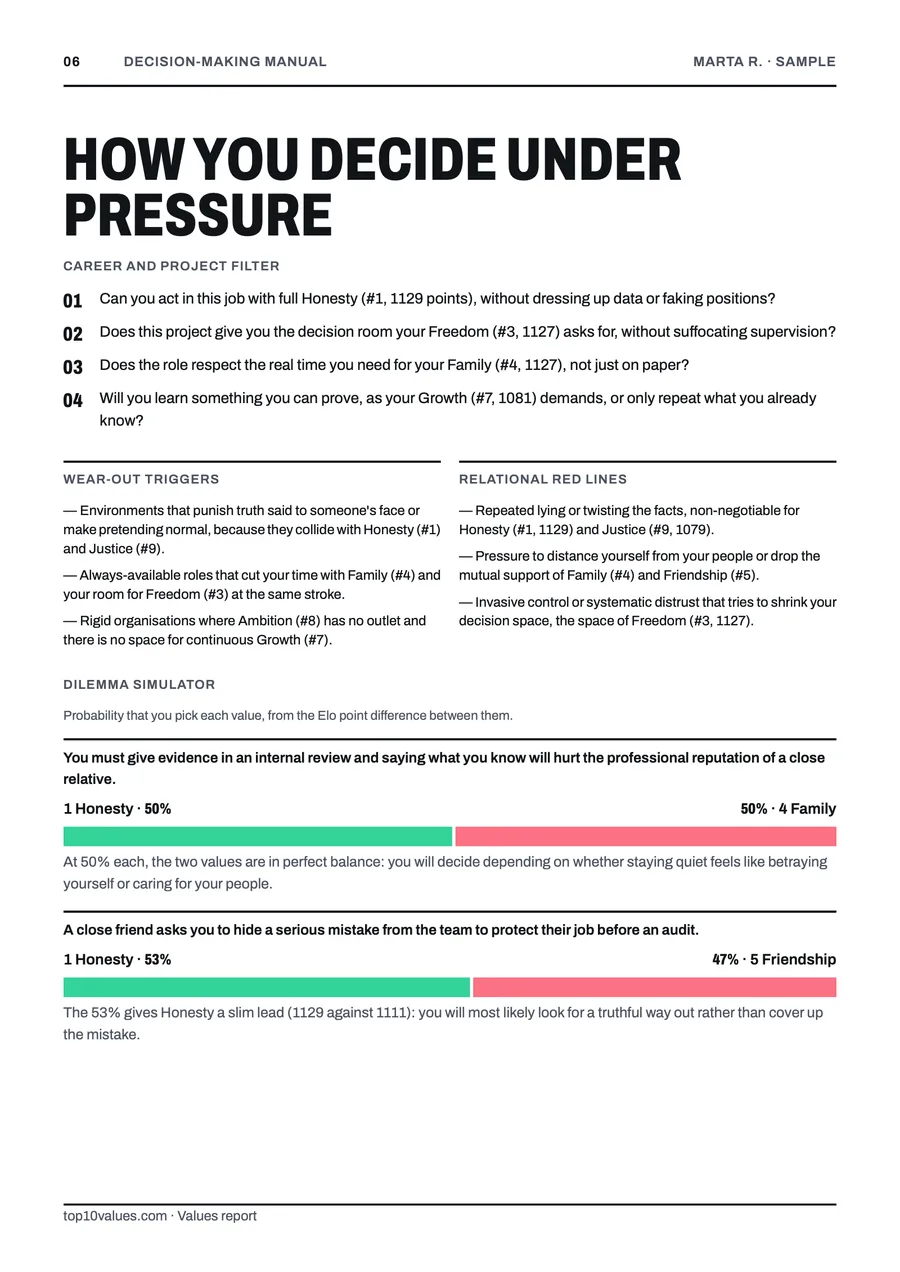
Sample page with fictional data (Marta R.), not yours. Your report is written from your own choices.
Frequently asked questions
What does it mean to have originality as a personal value? Examples
It means you care that what you do carries your own judgement and not just the standard answer. In everyday life it shows in concrete gestures: writing a birthday message around a shared memory instead of a stock phrase; opening a work presentation with the question nobody has asked; cooking a classic recipe with one change that makes it yours; choosing a gift designed for that particular person rather than the bestseller; or giving your view in a meeting even when it differs from everyone else's. It doesn't require eccentricity or inventing something never seen before, only that the result is recognisably yours.
What is the difference between originality, creativity and authenticity?
People often blur the three, but each answers a different question. Creativity is about making: the capacity to give shape to something, whether a song, a solution or a recipe. Originality is the quality of that something coming from a personal point of view rather than being interchangeable with what anyone else makes. Authenticity is the match between what you think, what you show and what you do. You can be highly creative within a well-known genre without seeking any originality; you can live authentically while following a family tradition to the letter; and you can pursue originality in a calculated way, to attract attention, with no authenticity at all.
If everything has already been done, is there any point trying to be original?
The complaint is ancient: the Book of Ecclesiastes already says there is nothing new under the sun. Yet every person combines what they have lived, read and seen in a way that is never repeated. The poet T. S. Eliot argued in his essay “Tradition and the Individual Talent” (1919) that a writer's contribution can only be understood in relation to what came before, not in opposition to it. Applied to ordinary life, the idea is useful: you don't need to start from zero, you need to know well what already exists and add your own angle. Originality lies more in the mix and the way of seeing than in absolute invention.
Is being inspired by others the same as copying? Where is the line?
Being inspired means taking an idea, a technique or an approach and transforming it with your own material until the result makes sense on its own terms; copying means reproducing something recognisably someone else's and presenting it as yours. Two questions help you find the line. First, if the person you took it from saw it, would they recognise their own work or something new inspired by it? Second, would you say where it came from out loud? Once you name your influences, borrowing stops being a problem and becomes a conversation. In professional, academic or commercial work there are also citation and intellectual property rules worth knowing and respecting.
What should I do if I find out an idea I thought was mine already existed?
It happens far more often than people think, and it isn't always bad faith. Memory sometimes keeps the content of something you heard or read and drops where it came from, a phenomenon psychologists call cryptomnesia. One of the best-known cases is George Harrison, whom a US court found in 1976 to have subconsciously copied the melody of “He's So Fine” in “My Sweet Lord”. If it happens to you, the sensible response is to acknowledge it, credit the source if you can find it, and ask what you can add that wasn't there already. As prevention, jot down where your ideas come from when you collect them.
How can I be original in a job with strict rules or protocols?
Originality doesn't have to fight the rules; it usually lives in what the rules leave open. A nurse follows the medication protocol to the letter but decides how to explain to each patient what is about to happen. An auditor applies the regulations but can present the findings so that management grasps them first time. Work out which parts of your job are non-negotiable for safety or legal reasons, respect them without argument, and look for your room to move in how you communicate, how you organise your time, how you train newcomers or which improvements you propose through the proper channels.
Is being original just a matter of going against the grain?
No. Going against the grain is a reaction: you take what the majority thinks and invert it, so your position still depends on everyone else's. Originality starts from a different question, “what do I think about this after looking at it calmly?”, and sometimes the answer matches the majority view. A useful test is to imagine nobody had offered an opinion on the matter before you: if your position holds, it is yours; if it disappears, it was a reflex. It also helps to notice whether you enjoy being right or being surprising more. When the second wins, originality has turned into a pose.
When Originality clashes with…
Doing things your own way, versus following your group or using the formula that already works and is faster.