Freedom
Independence
Ability to rely on yourself.

Independence is the ability and desire to make your own decisions without depending excessively on other people's approval, financial support or judgment. People who value independence prioritize building the resources—financial, emotional or practical—that let them decide their own course without feeling trapped by others' expectations. This doesn't imply isolation or rejecting collaboration, but being able to stand on your own when necessary. This value often shows up in career, housing or lifestyle decisions that favor autonomy even when a more comfortable or dependent option would be available in the short term.
What does this value mean?
Valuing independence means giving weight to standing on your own judgement, your own resources and your own two hands: being able to decide without waiting for someone’s sign-off, handling practical matters without someone else doing them for you, and not being at the mercy of a single salary, a single relationship or a single opinion. It is not about needing nobody, which no human being manages, but about choosing whom you rely on and for what, and keeping the ability to cope if that support disappears. Making it one of your own values means that when you weigh a job offer, a relationship or a family habit, you also ask “does this leave me able to stand on my own, or does it tie me to something I cannot control?”, and the answer shapes what you decide.
Anyone who ranks independence high will know scenes like these. The nineteen-year-old student who moves to another city and learns to file her own tax return instead of posting the paperwork to her father, even though it takes a whole afternoon and two calls to the tax office. The woman of fifty-eight who, after a divorce, sits down with the bank statement for the first time and decides to understand every direct debit before handing anything to an accountant. The eighty-year-old man who still walks to do his own shopping and asks someone to show him the new cash machine rather than asking his daughter to withdraw money for him. The designer who keeps two or three clients instead of one that pays for everything, because he knows what happens the day that client switches supplier. The person whose whole circle of friends thinks they should accept a promotion, and who takes a weekend to think it over calmly and decides the opposite. And the six-year-old who refuses to have her laces tied for her and would rather be late for school than give up doing it herself. The common thread is a specific discomfort: being in someone else’s hands for something you could learn to do or decide on your own. That discomfort is not pride or mistrust; it is the sense that your life is more securely held when there is more than one point of support and one of them is you.
What it does NOT mean
It is not isolation. People who confuse independence with owing nothing to anyone end up turning down help that would do them good and boasting of a solitude that, deep down, weighs on them. Nor is it the same as freedom, though the two are close: freedom is the room you have to choose your direction; independence is the capacity to sustain that direction with your own resources. You can have plenty of room and depend on someone else for every practical matter, and you can cope perfectly well on your own while living inside a routine you never chose. It does not mean being contrary: deciding the opposite of what everyone around you thinks just to prove they do not influence you is another way of depending on them, because your choice still revolves around their opinion. It does not mean having money to spare: some people on modest incomes organise themselves so that they rely on nobody for the essentials, and some people with considerable wealth cannot run a washing machine or disagree with their business partner. And it is not a demand to do everything unaided: handing your accounts to an accountant or your car to a garage is perfectly compatible with this value, as long as you understand enough to judge whether the job is being done well and could switch provider if it is not.
Related concepts
Why might it matter to you?
The worth of independence is usually discovered at a moment of loss: the colleague who knew how to run the payroll software retires, the parent who handled all the household accounts dies, the relationship ends with the person who always did the driving, the company that paid the only salary closes. At that moment a very practical question appears: what can I actually do without that person or that income? The earlier you started answering it, the less the loss knocks you over. That is why independence works like insurance you cannot buy, only build, bit by bit: every task you learn, every decision you dare to make without a consensus and every bit of money you set aside in a cushion of your own reduces the number of situations in which someone else gets to decide for you. It has an effect on the quality of your relationships too. When you do not depend on someone for everything, you can choose to stay with them for who they are rather than for what they sort out for you, and the relationship becomes more honest: you do not keep quiet out of fear of losing the roof, the job or the lift home. And it has an effect on your judgement. When you are in the habit of thinking decisions through on your own, even if you consult afterwards, you learn to tell the difference between what you want and what your role is expected to want, and that distinction saves years spent on other people’s paths. Understood well, independence does not separate you from others: it lets you come close to them because you want to, not because you need them for everything.
How can you live this value?
- Take an inventory of your dependencies. On a sheet of paper, list the important things for which you rely entirely on a single person or organisation: who knows the bank passwords, who drives, who cooks, who deals with the landlord, which client or employer your money comes from, whom you consult before every decision. The point is not to eliminate them all, but to see which ones you chose and which ones simply arrived. The second kind are the ones worth reviewing first.
- Each quarter, learn one task you currently hand over without understanding it. It might be reading a payslip, changing a tyre, cooking three complete meals, submitting a form on a government website or setting up your phone’s backup. You do not have to stop delegating it afterwards; it is enough that you have done it once and understand what is being done in your name.
- Build a cushion of your own, however small. An account in your name holding a few months of basic expenses, or whatever you can manage, changes how you negotiate a salary, argue with a partner or consider leaving a job that is harming you. If you share finances with someone, the cushion is not mistrust: it is the guarantee that neither of you is left empty-handed if something goes wrong.
- Before asking for an opinion, write down your own. When you face a significant decision, spend ten minutes noting what you would do and why before you ask your partner, your parents or your friends. Then consult, listen and change your mind if they persuade you. That way you know which part of the final decision is yours and which part you adopted to avoid contradicting anyone.
- Practise asking for help in a specific, limited way. It sounds contradictory, but people who value independence highly often need to train precisely the opposite. Ask for something small and precise (“could you help me carry the sofa up on Saturday from ten to twelve?”) rather than waiting until things overwhelm you or turning down help that is offered. Asking like this does not make you dependent: it lets you choose when to lean on someone.
- Keep at least one area of life that depends on nobody else. A hobby, a fixed slot each week, a friendship of your own or a small project where you need neither the permission, the company nor the approval of your partner, your family or your boss. That space protects your judgement during the periods when the rest of life is organised around other people, such as raising young children or caring for a relative.
Advertisement
What happens when you don't live up to this value?
When independence is neglected, it rarely shows all at once. What appears instead is dependence that has built up without any decision: one day you realise you have no idea what you pay for electricity because someone else always handled it, that you have not voiced an opinion at family gatherings for five years because someone speaks for you, or that you could not leave your job even if you wanted to because you do not have a single month of savings. That situation produces a vague unease, a kind of low-level fear of anything changing, which is often mistaken for general stress. It also shows in small decisions: you need to ask before buying a coat, changing hairdresser or accepting a dinner invitation, not out of consideration but because without that permission you do not dare. At work, the typical version is the person who will not take a step until their manager has approved it, even with more than enough experience to decide. If independence is one of your values, all this comes with a particular irritation with yourself, a sense of having shrunk. A useful question for finding out where you stand is this: if the person you rely on most for practical matters were gone tomorrow, what are the first three things you would not know how to handle?
The healthy side and the shadow
When does this value stop helping you and start limiting you?
Healthy expression
Standing on your own without shutting others out
In excess
Self-sufficiency that isolates
The shadow of independence is the inability to receive. It starts as a virtue (“I don’t want to be a bother”, “I’ll manage”) and hardens into a rule: never ask, never accept favours, never mention a problem until it is solved. The psychiatrist John Bowlby, in his work on attachment, spoke of “compulsive self-reliance” to describe people who learn early that asking for care does not work and organise their lives so as not to need it. You do not need any diagnosis to recognise the pattern in ordinary life: the person who carries everything up three flights of stairs on moving day rather than calling a friend, the one who hides an illness from their siblings so as not to worry them, or the partner who handles everything without delegating and then complains about carrying the whole load. The bill arrives in two forms. One is exhaustion, because nobody can carry everything indefinitely. The other is distance: other people end up feeling there is no room for them in your life and stop offering. There is a second, subtler shadow, which is independence as proof of superiority, when you look down on people who ask for help, who still live with their parents at thirty or who need to talk decisions over. The healthy version has three recognisable features: you can handle the essentials on your own, you accept help without feeling diminished, and you do not judge people who have not yet been able to stand on their own.
This value at work
At work, independence shows first in the kind of role you look for. You are drawn to positions where you own an area and answer for results, not ones that require sign-off at every step. Between two similar offers, you tend to prefer the one that lets you organise your diary and your methods, even if it comes with less support structure. Within a team, you are the person who researches before asking, who brings a proposal and not just a problem, and who gets restless when a project depends on approval from five layers of management. That trait is valuable: someone who can organise themselves without constant supervision saves their manager time and usually earns trust quickly. It also has a cost worth watching. In large organisations, a highly independent person can bypass other departments, hear too late about changes that affected their work or come across as someone who does not play for the team, when all they were trying to do was not bother anyone. An arrangement that tends to work is to agree with your manager which decisions you can make alone, which you should report afterwards and which need consultation first; with that map, your independence stops being a personal style and becomes a way of working that others understand. Financial independence comes into play too. If you are self-employed, the value pushes you not to depend on a single client; if you are an employee, it pushes you to keep your network and your skills alive so that a single employer is never your only way out. And if you manage people, the test is whether you give them room to decide, or whether your independence applies only to you while your team has to check everything with you.
This value in relationships
In friendship, independence takes a very recognisable form: you are the one who helps everybody move house and never mentions it when it is your turn to move. It feels natural to go with a friend to the hospital, but when you are the one having a medical test, you go without telling anyone and mention it once the results are in. From the outside, that can look like strength; from inside the friendship, it often leaves others feeling that the relationship runs in one direction only. Lasting friendships need both people to be able to give and to receive, and accepting a favour is also a way of trusting. There is, on the other hand, a side of this value that strengthens friendships: you do not need your friends to be available all the time, you cope well when they have other priorities for a season, and you can go months without seeing them without the relationship suffering. Nor do you need your group to think as you do in order to feel part of it. Another form of independence in friendship is having connections of your own: friends who did not come to you through your partner or your job and who know you outside those roles. People who lost all their personal friendships after pairing up or moving city often notice later how much support was there. The opposite risk is using independence as an excuse not to get involved: skipping the birthday because “everyone does their own thing”, or not asking a friend how they are because “if they need something, they will say”.
This value in love
In a couple, independence raises very concrete questions. Joint account, separate accounts or a mix? Who handles the car, who talks to the bank, who knows where the insurance papers are? How many evenings a week does each of you have for your own things? People who value independence rarely want a relationship in which every decision, friend and hobby merges, and they need to keep some space of their own to feel well within the bond. Handled well, that makes relationships stronger: two people who could live on their own and choose to live together have a different foundation from two people who cannot bear to be apart. A common example is the couple in which one partner stops working or goes part-time to look after the children. From the standpoint of this value, the question is not whether that is right or wrong but how to protect the person giving up their income: pension contributions, savings in their name, full access to the accounts and an explicit agreement about what happens if the relationship ends. Talking about it is not planning a divorce; it is making sure affection does not turn into vulnerability. The flip side appears when independence becomes a wall: you do not share your worries, you make big spending decisions without consulting because “it’s my money”, or you experience every compromise as a loss. Your partner may end up feeling they live with a pleasant flatmate. In a couple, the balance usually lies in chosen interdependence: you lean on each other for specific, agreed things, and each of you keeps the ability to stand alone if needed.
This value in family
In families, independence changes its face with every age. With young children, it means letting them do what they can already do, even if it takes longer or turns out worse: getting dressed, pouring their own water, clearing their plate, asking for bread at the bakery. Every time an adult does it for them to save time, they learn, without anyone meaning it, that their effort is not needed. With teenagers, independence is negotiated daily: what time to be home, how to manage pocket money, taking public transport to another city, deciding what to study. A reasonable approach is to widen the margin as they show they can handle it, and to explain limits rather than simply imposing them. In young adulthood, the big topic is leaving home, which in many places is delayed by the cost of housing. Living with your parents at twenty-eight does not make you dependent if you contribute at home, run your own life and have a plan; what matters is whether you are treated, or behave, as if you were still fifteen. In adult life, independence from your family of origin means being able to make decisions about your relationship, your children or your career without needing their approval, while keeping the affection. And in old age, the direction reverses: the father who should no longer drive or the mother who lives alone and has fallen twice put this value to the test, for the children and for the parents. Protecting their independence does not mean letting them do anything at all, but finding support that allows them to keep deciding what they can still decide: a grab rail in the shower, a personal alarm service, a paid taxi instead of taking the car keys away without a conversation.
This value and yourself
When independence ranks high for you, you are likely to feel calmer when there is a plan B, dislike owing favours and feel a quiet pride every time you sort something out unaided. It may go back to your history: some people learned to fend for themselves early because there was nobody at home to help, while others grew up very protected and discovered as adults the pleasure of doing things on their own. Neither story is better, but it is worth knowing yours, because it explains whether your independence is a choice or a defence. The other side shows up with some uncomfortable questions. When did you last ask for help before reaching your limit? Are there people close to you who offer and to whom you always say no? Do you struggle to delegate even to someone who would do it better? If it ranks in the middle or lower down, that is no failing either: it may mean that, at this stage, you value belonging, collaboration or the security of a group more, and that you are comfortable leaning on others. The only thing worth checking is that this reliance has been chosen and would not leave you without resources if circumstances changed.
What are you willing to sacrifice for this value?
Independence carries a clear price in comfort, time and sometimes company. Would you accept a lower salary in a job where you make the calls, rather than a better-paid one where everything needs approval? Would you move out of your parents’ home even if it meant sharing a flat, cutting back and giving up meals cooked for you? Would you spend a Saturday learning to manage your own finances instead of leaving them to your partner, who does it in half an hour? Would you turn down your family’s help with a house deposit if it came with conditions about where and how to live? Would you make an important decision your circle does not understand, knowing you will feel out of step for a while? Recall the last time you took the less comfortable path in order to keep standing on your own. If you have no regrets, independence already carries weight in your choices. If you always choose the option where someone else sorts things out for you and promise yourself you will learn “when it’s needed”, the value may be more an idea than a practice. And if the price you pay is facing alone problems that others would help you carry, it is worth asking whether what you are sacrificing is comfort or connection.
Signs you're betraying this value
You betray independence when you let someone else make an important decision for you to avoid the effort of thinking it through, or when you sign a document, a mortgage or a contract without understanding it because “someone else has already checked it”. Also when you change your opinion in every conversation depending on who you are talking to, or when you do not dare to spend, go out or change something without a permission nobody has asked you to seek. A clear warning sign is going years without savings of your own when you could have built them, or relying on a single source of income while knowing it is fragile. And there is a less obvious betrayal, in the opposite direction: refusing help you need, putting your health or your finances at risk rather than asking for anything, and calling that independence. Standing on your own is not proving you can cope with everything; it is keeping the ability to decide your own life.
Turning the value into goals
Value
Independence
Behavior
Once a week, handle on your own a practical task or piece of admin you usually leave to someone else, even if it takes longer
Goal
Within six months, be able to explain where your income comes from and where it goes, hold a cushion of savings in your name and know how to do the three household or admin tasks you relied on others for most
Habit
Before every significant decision, write down your own position in five minutes and only then consult whoever you wish
Questions to reflect on
- If the person you rely on most for practical matters were gone tomorrow, what three things would you not know how to handle, and what is stopping you from learning one of them this month?
- Which recent decision did you make more to avoid contradicting someone than out of conviction, and what would you have chosen without that pressure?
- What does your money depend on today, and how long could you support yourself if that source dried up?
- Whom have you turned down when they offered to help, and what would have changed if you had accepted?
- Which part of your life is yours alone, needing neither permission nor company, and how much time did you give it last month?
- If someone who loves you described your independence, would they talk about strength, about distance, or about both?
How much are you living this value?
Look back over the last four weeks and pick out one situation in which you handled something on your own that you would previously have delegated, and another in which you accepted help without feeling in debt. Give yourself a mark from one to ten for how well you could sustain your practical life, your finances and your decisions if a key person were absent for a while. Below a seven, pick one dependency from your inventory and set the first concrete task to reduce it. Above a nine, check as well that you are not paying for that score with isolation.
When two values clash
Independence clashes with Family when the group’s expectations (living nearby, deciding together, carrying on the family business, caring for older relatives in a particular way) collide with your need to decide for yourself. There is rarely a clean way out: many people find the balance in chosen involvement, with agreed times and tasks, rather than accepting everything or breaking away. With Love, the clash appears when caring for someone means merging money, home, schedules and friends, and every step towards union feels like a loss; it helps to distinguish between dependencies you agree on and those that creep in unspoken. With Loyalty, when backing your team, your boss or your group means keeping an opinion to yourself or supporting a decision you do not share. With Financial security the relationship cuts both ways: a cushion of your own feeds independence, but a stable post in a rigid structure can take away your room to manoeuvre; self-employment gives you autonomy and, in return, less predictable income. With Humility, the friction is help: admitting you cannot manage something and asking for support is harder for someone whose identity is built on standing alone. With Friendship, when you give a lot and let yourself receive little, and the relationship ends up lopsided. Freedom is a close but distinct ally, as its own page explains: freedom is the room to choose, and independence is the capacity to sustain what you have chosen. Trust is the ally that best balances this value, because it lets you lean on other people without feeling you have lost control. And Courage is often its companion at decisive moments, such as leaving home, quitting a job or saying no to your family.
Is “Independence” one of your top 10 values?
Find out by playing and comparing this value with the other 49
How the Elo ranking works and its limits in the methodology.
What does the paid report include?
When you finish the 100 comparisons you will see your Top 10 on screen. If you want to go further, there is a PDF report on your personal values: €9.95 (VAT included), one-off payment. To buy it you need to save your game with a Google account.
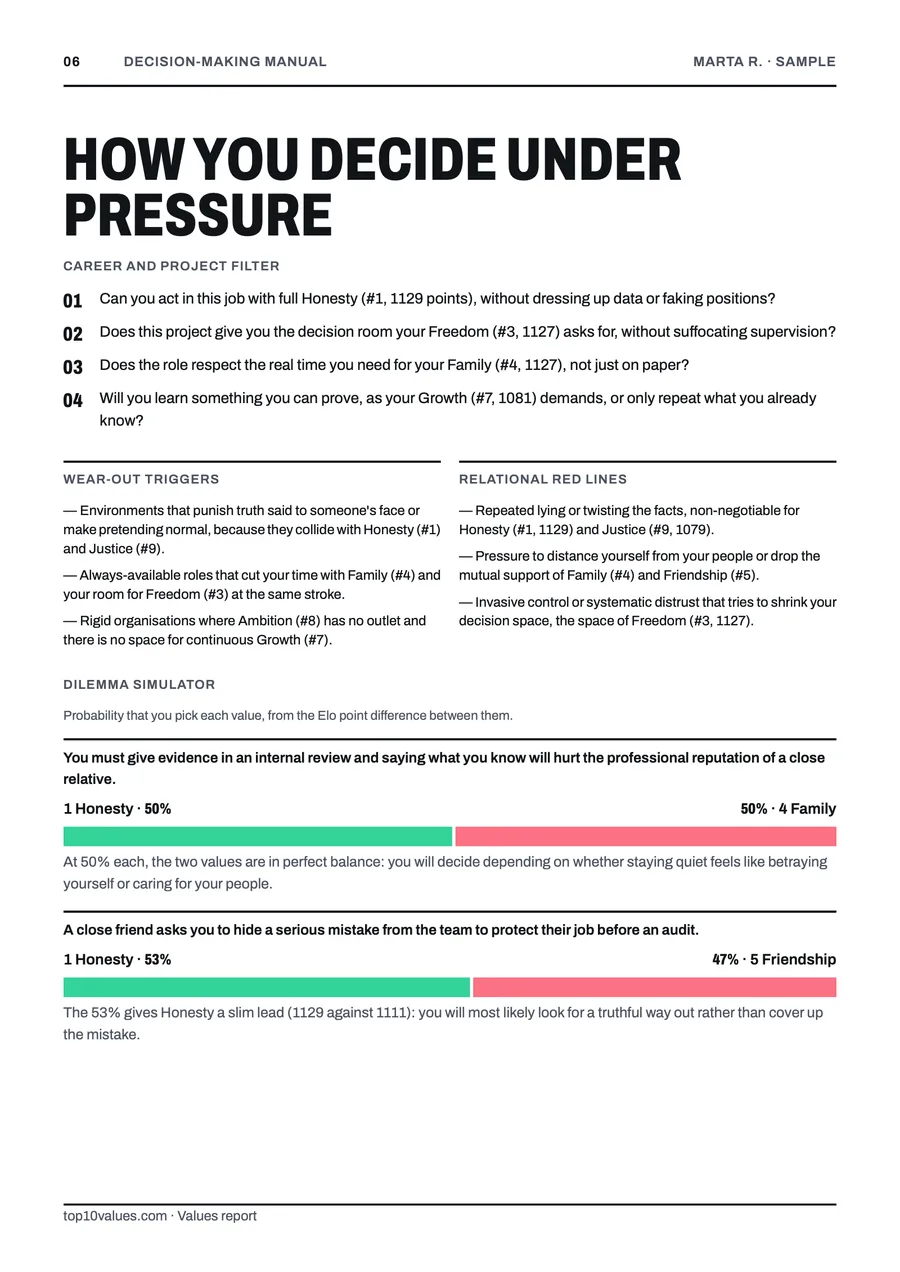
Sample page with fictional data (Marta R.), not yours. Your report is written from your own choices.
Frequently asked questions
What does it mean to have independence as a core value, and what are some everyday examples?
Having independence as a core value means placing importance on being able to decide and sustain your life without being in the hands of a single person, a single income or a single opinion. Everyday examples: learning to deal with your own paperwork instead of always leaving it to your partner; keeping a savings account in your name even if you share expenses; working out your position before asking for advice; maintaining friendships of your own outside your relationship and your job; letting a seven-year-old buy bread at the corner shop; or asking to be shown online banking at seventy rather than having a grandchild do it for you. What ties these together is that you choose what you lean on and keep the ability to stand on your own.
How is independence different from freedom and authenticity?
They cover neighbouring ground. Freedom is about how much genuine room you have to choose your direction. Independence is the capacity to sustain that direction with your own resources, judgement and skills, without needing someone else to sort it out for you. Authenticity is about what you show and do being consistent with who you are. You can have a lot of freedom and little independence, like someone who could choose any job but relies on their parents to pay the rent, and a lot of independence with little freedom, like someone who supports themselves in a job with rigid hours they never chose.
Is it bad never to want to ask for help?
Not asking for help with something occasionally is fine, but turning it into a rule usually costs you. Signs that independence has become rigid include refusing help you need, only mentioning problems once they are solved, feeling ashamed when you accept a favour, and ending up exhausted or resentful from carrying everything. To change it, start with small, specific, time-limited requests to people you trust, and notice what happens: the relationship almost always improves rather than suffers. If it feels very hard, or there is a painful history behind it, talking it through with a psychologist or counsellor in a session can help.
Can you value independence and still have a stable relationship?
Yes, and many lasting relationships rest on it. The key is to distinguish independence from distance. Keeping friends of your own, a hobby, some financial autonomy and the ability to disagree does not threaten a couple; what threatens it is using those spaces to share nothing. It helps to talk explicitly about practical matters (how money is organised, which decisions are made together, how much time each of you has for your own things) and to revisit them when circumstances change, for example when you have children, move house or one of you stops working.
How can I encourage independence in my children at different ages?
The general idea is to let them do what they are already capable of and widen the margin gradually. In early childhood: getting dressed, tidying their things, serving themselves and choosing between two options. Around six or seven: small errands such as paying in a shop or packing their school bag. In the pre-teen years: managing pocket money, walking to nearby places and organising their homework. In adolescence: using public transport, cooking something simple and making decisions about their studies with your support. Every child has their own pace and the surroundings matter; the essential thing is not to do for them what they can already do, and to tolerate their doing it less well at first.
Do you need financial independence to be an independent person?
It helps a great deal, but it is not the whole story. Financial independence, even partial, gives you room to decide without fear of being left with nothing and protects you in situations such as a break-up or a redundancy. Still, independence also has a practical side (knowing how to handle everyday life) and a side of judgement (deciding without needing everyone’s approval), and both can be developed on a low income. If you currently depend on someone financially by agreement, while studying or while caring for relatives, the sensible thing is to understand the household finances, have access to the accounts and, if possible, put something aside in your own name.
What should I do when an elderly parent starts losing their independence?
The most useful step is usually to separate what they can no longer do safely from what they can still decide. Taking every task away at once, such as the car, the shopping and the bills, is often experienced as humiliation and can sink their mood. Ask what worries them, offer support that preserves their autonomy (home adaptations, a personal alarm, alternative transport, someone who goes with them to the shops or the bank rather than going on their behalf) and agree with your siblings who takes care of what. When a hard decision has to be made, such as giving up driving or moving house, involve them as far as possible and lean on their GP or your local social services.
When Independence clashes with…
Invented scene. Clara is 29, has a steady contract and wants to move into a small flat on her own. Her father, who loves her, keeps saying that paying rent is throwing money away when there is a spare room at home. Independence is not looking for a fight: it wants to come home at an hour she does not have to explain. Family answers that living together is also a way of looking after each other, and that her mother will be left alone with the silences. Her partner, Sergio, suggests something else: moving in together. Love finds it natural, but Clara fears swapping dependence on her parents for a more comfortable one. And loyalty to an old promise (looking after her grandmother on Sundays) weighs more than she admits. It may help to live alone for a year with a review date, keep one fixed dinner at home, and tell Sergio that sleeping at his place three nights a week is not the same as sharing keys. More scenes in conflicting values.