Achievement
Mastery
Deep mastery of a skill.

Mastery is the pursuit of deep, technical command of a specific skill or discipline, beyond a merely functional or superficial level. People who value mastery invest sustained time in perfecting the details of their craft, prefer to solve complex problems that few can tackle, and feel genuine satisfaction in flawless execution, not just in the final result. This value requires patience, because real command of any field is built over years of deliberate practice, not through shortcuts. Unlike ambition, which looks toward external goals, mastery focuses on the intrinsic quality of the technical ability you have developed.
What does this value mean?
Mastery is deep command of a specific skill, built over years of attentive practice, to the point where you can do well what other people barely manage, and you also understand why something works or fails. As a value, it means choosing one thing, or very few, to give a large share of your life to, and accepting the deal that comes with it: a great deal of repetition, long stretches with no visible progress, and giving up on standing out in almost everything else. It is not measured by a qualification or a job title but by what you can do when things get complicated: the unusual case, the part that will not fit, the surprise no manual mentions.
If mastery is among your top values, one of these scenes may feel familiar. The electrician who, after twenty-five years in the trade, walks into the meter room of a block of flats, hears a breaker humming and knows where the fault is before reaching for the tester. The sign language interpreter who no longer carries words across one by one but intentions, and can read in a Deaf client’s face that something has not landed before they say so. The amateur potter who, at sixty, has spent three years trying to centre clay on the wheel, and one afternoon finally feels in her palms the exact moment the lump stops wobbling. The family doctor who needs only two sentences from a patient to know which question to ask next. The fourteen-year-old who has spent months studying a single chess opening and now sees plans on the board that his father cannot see. What they share is knowledge that no longer lives only in the head: it is in the hands, the ear, the judgement. The chemist and philosopher Michael Polanyi put it memorably in The Tacit Dimension (1966): we can know more than we can tell. Hubert and Stuart Dreyfus described something similar in their model of skill acquisition: beginners follow rules, while experts take in the whole situation and respond almost without deliberating. Mastery as a value is the wish to reach that second place in something that matters to you.
What it does NOT mean
It is not innate talent. Some people begin with a natural advantage, but mastery shows precisely in the opposite: in what someone has built by returning again and again to what they could not do. Nor is it the same as excellence, close as they are. Excellence has to do with the attention you give each job, and you can show it in your first week; mastery is the accumulated command that only arrives with years. You can work with excellence and no mastery, and, unfortunately, have mastery and work half-heartedly. It is not simply clocking hours: someone who has driven for thirty years without ever correcting their habits does not drive like an expert, just with more routine. It is not success or recognition: the alterations seamstress on your high street who takes in a jacket without the seam showing may have more mastery than plenty of well-known names, and nobody has given her an award. It does not have to be your profession: there is mastery in sourdough baking, in climbing, in knitting, in running an allotment or in telling stories to small children. And it is not knowing about everything: mastery is deep and narrow by definition, and usually sits alongside a calm ignorance of almost everything else.
Related concepts
Why might it matter to you?
Mastery matters, first, because of the kind of satisfaction it brings, which differs from finishing a task or being praised. It is the pleasure of noticing that something that used to take effort now flows, and that this frees you to deal with the hard part. The psychologist Mihaly Csikszentmihalyi described in Flow (1990) the states of total absorption that appear when a challenge matches your skill; the more you command something, the more interesting challenges you can take on without being overwhelmed, and the more often that feeling turns up. Second, it matters because it gives shape to time. Plenty of people reach fifty feeling that their years have scattered into assignments, shifting interests and abandoned hobbies. Someone who has pursued mastery in one thing can look back and see a line: what they did at twenty-five, what they did at thirty-five, what they do now. That continuity holds your sense of self together in hard seasons. Third, mastery gives you room. People who can do what few others can usually have more leverage to negotiate terms, choose projects or say no, although this depends heavily on the field and the market. And finally, it matters to everyone else. When a gas installation, a legal translation or an operation goes well, someone behind it spent years on what the rest of us take for granted. A society without people who command their craft fills up with things that almost work.
How can you live this value?
- Choose your ground with a question measured in years, not weeks. Before committing, ask whether you can picture yourself practising this ten years from now on an ordinary Tuesday, with no audience and nothing new about it. Mastery demands a long relationship, so pick something whose day-to-day you enjoy, not just its image. If you are torn between two fields, give each a six-month trial before deciding. Trying several things at the start is not a lack of focus: it is how you find the right ground.
- Practise right at the edge of what you can do. The psychologist K. Anders Ericsson used the term deliberate practice for practice that targets one specific aspect you have not yet mastered, with a clear goal and a way of telling whether you are improving. In everyday terms, it means you stop repeating what you already do well. If you play guitar, isolate the two bars you always fluff; if you write reports, rewrite only the conclusions until they make sense without the rest; if you teach, record the five minutes when the room drifts off and study them.
- Find someone who sees what you cannot. Almost no craft is mastered alone. A teacher, a coach, a more experienced colleague or a group of peers willing to review your work frankly will save you years, because they spot habits you no longer notice. Ask for concrete corrections (“what would you change first?”) rather than general opinions, and show the work again once you have applied them, so they can check you understood.
- Keep a record so you can compare yourself with yourself. Film your presentations, photograph your pieces, keep versions of your code or log your training times. Memory is a poor judge of slow progress: without a record, months on a plateau feel endless and real gains go unnoticed. Looking calmly at what you were doing a year ago is often the best remedy for the urge to give up.
- Treat plateaus as part of the job. George Leonard, in Mastery (1991), describes the path as short spurts of improvement separated by long plateaus where you seem to go nowhere. People who pursue mastery learn to keep practising through those stretches without demanding excitement from them. One practical help is to set process goals during a plateau (“thirty minutes of technique four days a week”) instead of outcome goals.
- Teach someone who is one step behind you. Explaining what you do forces you to put into words what you knew without knowing it, and exposes gaps you never suspected. Offer a beginner an hour a month, write a short guide to the mistakes you see most often, or take on a trainee. As well as sharpening your own command, it is how you make sure what you have learned does not disappear with you.
Advertisement
What happens when you don't live up to this value?
When mastery is one of your values and you are not living it, a hard-to-name feeling sets in: that of being a permanent beginner. You start things with enthusiasm, drop them as soon as the first plateau arrives and, over the years, collect a cupboard of hobbies at twenty per cent: climbing shoes barely worn, an Italian course half done, three photography books still in their shrink-wrap. At work the symptom is similar. You move role or project before you truly understand what you were doing and, a decade later, feel you have lived your first year ten times over in ten different places. You can come to feel interchangeable, someone anyone could replace in a fortnight, and that quietly wears down your confidence. Sometimes mastery goes unlived out of fear: if you never give yourself fully to one thing, you never have to find out where your ceiling is. And sometimes the obstacle is more mundane: shift patterns, caring duties or insecure work that never leave two clear hours for practice. Naming that helps you avoid mistaking a lack of time for a lack of commitment.
The healthy side and the shadow
When does this value stop helping you and start limiting you?
Healthy expression
Deep command with an open mind and a wish to pass it on
In excess
Expert rigidity
Mastery can go wrong in several ways. The first is rigidity. Shunryu Suzuki wrote in Zen Mind, Beginner’s Mind (1970) that in the beginner’s mind there are many possibilities, but in the expert’s there are few. People who command a craft can stop looking: they apply what has always worked, dismiss new methods untried and mistake their habits for the truth. The second is difficulty teaching. The better you know something, the harder it is to remember what not knowing it was like, a bias that Colin Camerer, George Loewenstein and Martin Weber studied in 1989 under the name the curse of knowledge; the result is the expert who explains too fast, loses patience and concludes that anyone who cannot follow is not up to it. The third is fusing your identity with the skill. If your craft is the only thing holding you up, an injury, retirement or a technical shift can pull the floor away: think of Linotype operators when phototypesetting reached the print works, or of a dancer whose body no longer answers as it used to. The fourth is using command as a border: keeping tricks to yourself to stay indispensable, setting pointless tests for newcomers or looking down on people who practise your craft as a hobby. The healthy version shows in keeping a beginner’s curiosity, accepting that someone younger can teach you something, caring more about passing things on than guarding them, and having other supports in life besides the craft.
This value at work
At work, mastery often clashes with the way careers are organised. Many organisations reward people who command a craft by taking them out of it: the good technician ends up coordinating technicians, the great teacher ends up as head, the brilliant developer ends up in budget meetings. Laurence J. Peter popularised in The Peter Principle (1969) the half-joking idea that in a hierarchy people tend to rise to their level of incompetence. If mastery weighs heavily on your list, be clear before accepting a promotion about whether you want to stop doing what you do well, and look for employers with technical career tracks that let you progress without leaving practice behind. Another tension is time. Mastery needs hours of unproductive practice: trying, getting it wrong, redoing, studying an odd case. In places that measure only daily output, those hours look like a luxury. It helps to negotiate them openly, for instance through an improvement project agreed with your manager, rather than stealing them on the quiet. If you lead a team, your job is to protect the long learning of your most skilled people and to insist on documenting what only one person knows, because a team that depends on someone’s memory is one sick day away from being left in the dark. And watch for obsolescence: tools change, principles last longer. Someone who understands why something works adapts better than someone who has only mastered one version of a program or a machine.
This value in relationships
In friendship, mastery has two faces. The good one is that many of the strongest friendships form around a craft or shared practice: the climbing partners who have been roped together for fifteen years, the choir, the people from the bookbinding workshop. Practising alongside someone for years builds a particular trust, because you have watched each other fail and improve. And mastery handled well is generous: the friend who knows bikes and shows you how to change an inner tube instead of doing it for you, the designer friend who looks over your CV on a Sunday afternoon. The difficult face shows up in three ways. One is time: intensive practice eats weekends, birthdays and dinners, and friends who do not share your passion can feel pushed into the background. Another is the one-track mind: someone wrapped up in a craft can turn every conversation into a lesson or judge others by how much they know about it. The third is becoming the permanent help desk for your whole circle, so that friends seek you out more for what you can do than for who you are. It is worth setting limits kindly (“I’ll look at it, but this time we do it together”) and looking after friendships that have nothing to do with your field, because they remind you that you are more than your skill.
This value in love
In a couple, mastery often turns up as a third presence in the home: the hours in the studio, the workshop, at training or at the computer going over a case. For the person living with you, it can feel admirable or like a rival, and often both depending on the season. It helps a great deal to explain what the practice gives you and to agree its hours rather than impose them, just as you agree who does which chores or how much time goes to each family. A simple test is to ask whether your partner knows what you are working to improve these months and why it matters to you, or only knows your absences. When you both have demanding crafts, the risk is that home becomes a stopover between two practices, so protect some shared time that is not about logistics. It is also delicate to treat your partner as your apprentice: correcting how they cook, drive or assemble furniture from the authority of the one who knows more cools a relationship fast. And there is a lovely version of mastery in love: treating life together as a craft that is also learned over the years, in which you gradually refine how you argue, how you apologise and how you read the other person’s tiredness.
This value in family
In families, mastery is played out above all in passing things on. Some crafts travel down the generations, and it is a joy to watch a grandfather teach his granddaughter to graft a fruit tree, or a mother patiently teach her teenage son to sew. But the wish to pass something on can harden into pressure: the father who takes it for granted his son will inherit the workshop, the mother who experiences her daughter quitting the violin after eight years as a failure. It is worth separating the gift from the expectation. With children, a common question is when to let them give up an activity. There is no rule, but it helps to tell apart whether they want to stop because they have hit an uncomfortable plateau, which is a natural part of the road, or because it genuinely means nothing to them; in the first case, agreeing a deadline (“we finish the term and then we talk”) is sometimes enough. You can also teach by example: letting them see you practise something steadily, get frustrated and carry on is worth more than any lecture about effort. Another sensitive point is how care is shared. Years of small children or dependent parents usually force you to park your practice, and not always evenly between partners or siblings. Saying this out loud, and taking turns so that each person keeps a little of their ground, avoids resentments that can take years to surface.
This value and yourself
Choosing mastery as a value says you are drawn to depth more than variety, and that you tolerate, or even enjoy, the repetition that bores other people. It also says something about your relationship with time: you find it worthwhile to invest now in something that will only pay off years from now, which is not common. It is worth looking at where the urge comes from. If it comes from love of the subject, from how it feels to do something hard well, it is a very healthy engine. If it comes from fear of being ordinary, from a need to be indispensable or from a childhood in which only achievements were celebrated, it can turn into a race without a finish line in which you never command enough. One useful clue: think about how it sits with you when someone younger overtakes you in your field. If it makes you curious, that is a good sign; if it feels threatening, some identity is at stake. Ask yourself, too, what would happen if tomorrow you could no longer practise your craft. If the answer is that you would not know who you are, it may be worth widening the supports in your life without giving up depth.
What are you willing to sacrifice for this value?
Mastery asks for long, unglamorous sacrifices. Would you give three or four evenings a week, for years, to something nobody may ever see? Would you accept a job with less pay or less prestige because the person you could learn most from works there? Would you turn down a promotion that takes you away from practice? Could you bear doing it badly again for months while switching technique, knowing the old method gave you acceptable results? Would you put your work in front of someone better so they can pull it apart? Think of the last time you chose depth over comfort or variety. If you remember it with satisfaction, even though it cost you a trip, a holiday or someone’s sulk, mastery already guides your choices. If you always leave it for when circumstances improve, mastery may be more an ideal for you than a craft you actually work at. That leaves the reverse sacrifice, easy to forget: setting down the workshop, the piano or the code for a whole weekend because someone you love needs you, and doing it without feeling it as a loss.
Signs you're betraying this value
The first symptom of mastery turning into reputation is still telling people how you did it ten years ago without having faced a hard case in a long while. You also betray it when you stop asking for correction because you dislike anyone seeing your mistakes, when you keep repeating what already comes easily so as not to expose yourself, or when you quit every time you reach a plateau and call it a change of interests. Another betrayal is hoarding what you know to remain indispensable, or dismissing a new tool without trying it because it would make you a beginner again. And there is a quieter one: neglecting the body that sustains your craft, ignoring the ache in your wrist, your back or your voice until an injury makes the decision for you.
Turning the value into goals
Value
Mastery
Behavior
Devote each practice session to a single specific aspect you have not yet mastered, instead of repeating what already comes easily
Goal
Choose one core skill this year, get someone more experienced to review your work every month, and in December compare your record with January’s
Habit
At the end of each session, write one line on what you tried to improve, what went wrong and what you will try next time
Questions to reflect on
- If you could spend the next ten years mastering only one thing, what would you choose, and what does that choice tell you?
- In which area of your life have you been repeating what you already know how to do instead of practising what you find hard?
- Who could spot mistakes in your work today that you no longer see, and what stops you showing it to them?
- How do you react when someone with less experience teaches you something about your craft?
- How many times have you dropped something just as the first plateau arrived, and what did you tell yourself to justify it?
- What would be left of you if tomorrow you could no longer use the skill you are proudest of?
How much are you living this value?
Think of the skill you most want to master. Over the past month, how many hours did you spend truly practising it, working on something you cannot yet do, and how many simply using it as usual? Give yourself a score from one to ten for how far you have come in it over the past year, looking at a record if you have one rather than at your impression. If the score is below seven, pick one specific aspect to work on this week and find someone who can tell you whether it is improving.
When two values clash
Mastery collides head-on with Curiosity and Adventure. Curiosity pushes you to open new doors, while mastery asks you to stay in a single room for years; adventure seeks the unknown, while mastery delights in knowing one territory down to its last corner. Many people resolve the tension in seasons, alternating years of depth with spells of exploration, or choosing one core craft and letting curiosity roam over everything else. With Learning the relationship is a family one, yet different: learning nudges you towards a new subject once you have the basics, and mastery asks you to keep going once the basics have lost their charm. With Freedom it appears as commitment: mastering something ties you, to a place, a timetable, sometimes a teacher. With Balance and Family the clash is about hours: every evening in the workshop is an evening away from home, and anyone pursuing mastery needs to agree that time so it does not turn into chronic absence. Health comes in when the body is the tool: musicians, athletes, surgeons and cooks know overuse injuries well. With Humility the relationship is decisive: without humility, mastery hardens into rigidity; with it, you can keep learning from anyone. With Recognition and Success the difference is where the effort points: mastery looks at command of the craft, recognition at other people’s gaze. You can have one without the other, and confusing them leads you to choose the showy over the deep. With Independence there is a paradox: command brings autonomy, but reaching it almost always requires teachers. Its natural allies are Discipline, which supplies the consistency; with Excellence, which supplies care for each piece; and with Contribution, because anyone who commands a craft has something valuable to pass on.
Is “Mastery” one of your top 10 values?
Find out by playing and comparing this value with the other 49
How the Elo ranking works and its limits in the methodology.
What does the paid report include?
When you finish the 100 comparisons you will see your Top 10 on screen. If you want to go further, there is a PDF report on your personal values: €9.95 (VAT included), one-off payment. To buy it you need to save your game with a Google account.
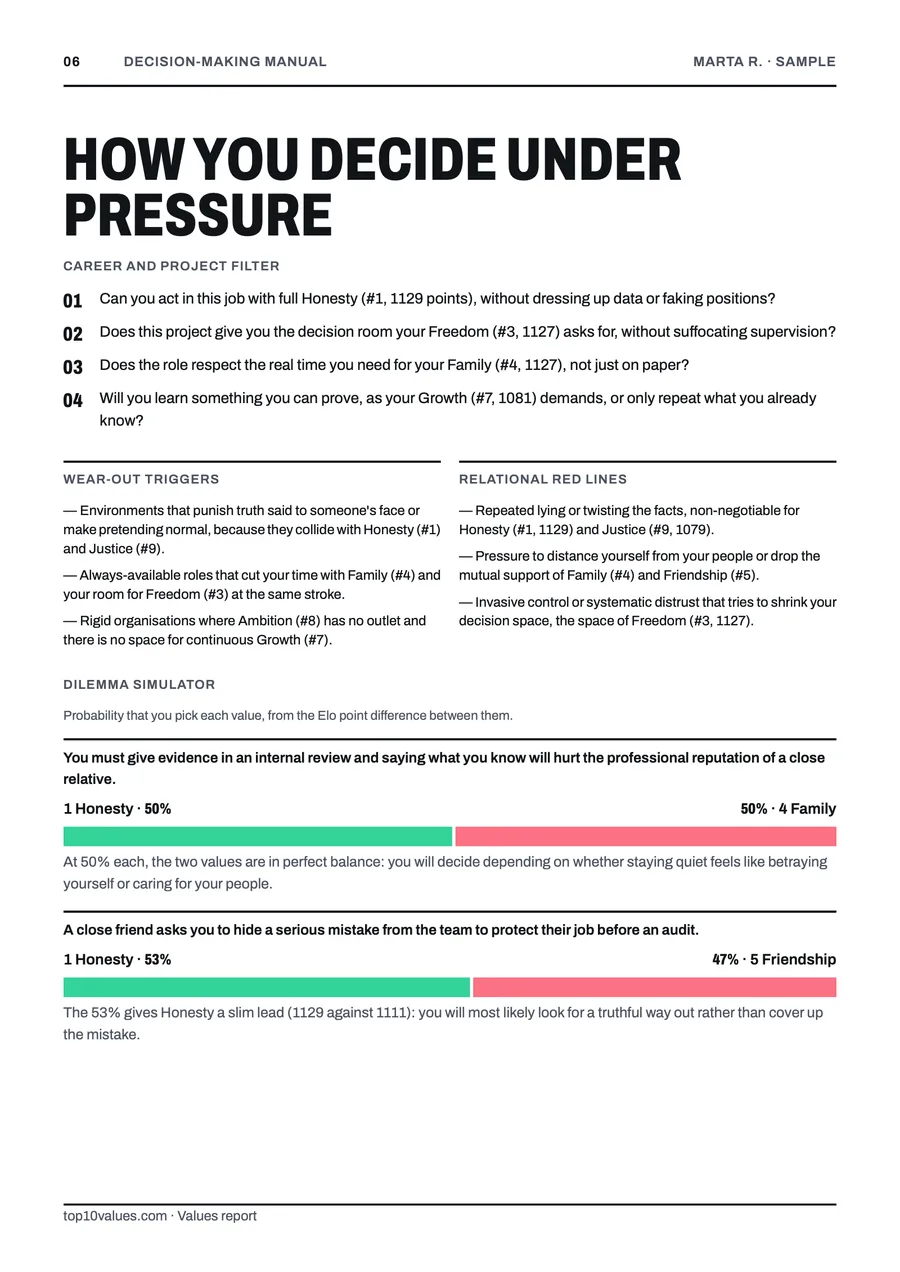
Sample page with fictional data (Marta R.), not yours. Your report is written from your own choices.
Frequently asked questions
What does it mean to have mastery as a personal value, and what does it look like in everyday life?
It means that commanding a skill in depth sits at the centre of how you decide to use your time, work and energy. It shows in concrete choices: turning down a promotion that takes you away from practice, spending Sunday mornings in the woodworking shed, choosing a job because of the person you will learn from, giving years to one style of climbing or one medical specialty rather than dabbling. You do not have to be a recognised figure or to have arrived already: holding mastery as a value means orienting your life towards that command, even if you are only in year three of a twenty-year road.
Does it really take 10,000 hours to master something?
Not as a fixed rule. The figure was popularised by Malcolm Gladwell’s Outliers (2008), which drew on K. Anders Ericsson’s 1993 research on violinists at a Berlin music academy. Ericsson himself, in Peak (2016), written with Robert Pool, explained that the number was a rough average for one particular group at a certain age, not a magic threshold, and that the hours required vary widely from field to field. What his research does support is that the kind of practice matters more than the amount: hours focused on what you have not yet mastered, with clear goals and someone to correct you. Many hours repeating what you already know may give you less than far fewer well-aimed ones.
What is the difference between mastery, excellence and learning?
They are neighbouring values that look at different things. Excellence attends to the care in each specific job: you can have it from day one. Learning is the pleasure of turning experience into new abilities, and it tends to nudge you on to a new topic once you grasp the essentials. Mastery is the deep command you only reach by staying a long time in one field, well past the point where learning becomes slow and unglamorous. Put simply: excellence looks at the piece in front of you, learning looks at the next thing you could learn, and mastery looks at how far you can go in one thing. It is common to rank two of the three highly and feel the tension between them.
What should I do when I have been stuck for months on something I want to master?
First, remember that plateaus are normal in almost any skill. George Leonard, in Mastery (1991), describes progress as short spurts separated by long periods with no visible improvement, and suggests learning to enjoy practice during those periods rather than always waiting for the next jump. Next, check whether your practice is still deliberate or has become automatic: if every session repeats what you already do well, standing still is the logical result. Try changing one element: find someone to watch you, record yourself, work on a specific aspect you tend to avoid, change the pace or the difficulty. And look at your record from six months or a year ago: the feeling of being stuck often does not match what the record shows. If after all that you are neither progressing nor enjoying it, it may be time to ask whether this is still your ground.
Is it too late to pursue mastery at 50 or 60?
It depends on the field, but it is almost never too late to make serious progress. Some skills have a physical component where age sets clear limits, such as elite sport, and others where life experience works in your favour: writing, pottery, carpentry, gardening, mediation, translation. The Japanese painter and printmaker Katsushika Hokusai wrote in the afterword to his One Hundred Views of Mount Fuji, published in 1834 when he was in his mid-seventies, that nothing he had drawn before seventy was worth much notice and that he hoped to keep improving past a hundred. Without turning it into a compulsory model, the idea holds: mastery is not a race against youth but a long relationship with something.
How can I teach what I know without losing patience with beginners?
Start by accepting that you will struggle to remember what not knowing felt like, a well-known effect among people who have mastered something. It helps to watch a beginner for a few minutes without stepping in, to see where they actually get stuck rather than where you assume they do. Break what you do into smaller steps than seem necessary, and say out loud what you do automatically: “now I look here because…”. Correct one thing at a time and let them get things wrong where it is not dangerous. And remember how your best teachers treated you: they were rarely the most brilliant, but they were the ones who kept you practising.
When Mastery clashes with…
Going deep into one thing for years, versus sampling many, living new experiences or sharing out your time with measure.