Achievement
Excellence
Pursuit of the highest quality.

Excellence is the commitment to reaching the highest possible level of quality in what you do, beyond the acceptable minimum or what others expect. People who value excellence review, polish and refine their work even when it already meets the basic requirements, because their internal standard is more demanding than any external evaluation. This value differs from success in that it doesn't depend on the final result or the recognition received, but on the process and the care put into every detail. It can create tension with efficiency if not managed well, since pursuing perfection sometimes clashes with the deadlines available.
What does this value mean?
Excellence is the care you put into what you do, measured against a standard you have chosen yourself rather than against what the person next to you is doing. It is the habit of asking, before you call something finished, whether you would put your name to it and whether you would be comfortable showing it to someone who knows the subject. As a value, it means deciding which things you will not settle for "passable" on, and accepting what that costs: more attention, more checking, sometimes more time, and the odd thing given up. It does not demand that everything be perfect. It demands that you know what deserves your best work and give it.
People who put excellence among their values recognise themselves in very specific scenes, most of them unglamorous: the joiner who sands the back of a drawer that nobody will ever turn upside down to look at; the cook on the school dinner shift who tastes the gravy before the first tray goes out, even after ten years of making it; the ward nurse who reads the medication chart aloud one more time before she draws up the dose; the subeditor who leaves a text overnight and rereads it in the morning, knowing a rested ear hears what a tired one misses; the mechanic who, after fitting a part, wipes the smear of grease off the dashboard without being asked; the student who, with the exam already handed in, wonders whether she has understood the topic or only learned how to pass it. The Greek word usually translated as "virtue" or "excellence", arete, describes in Aristotle the good functioning of a thing according to what is proper to it, and in the "Nicomachean Ethics" it is acquired through repeated practice, the way you learn to play the lyre by playing it. The sociologist Richard Sennett, in "The Craftsman", describes a close idea: the desire to do a job well for its own sake, not because someone is applauding. That is the root that matters here. Excellence does not begin with the result other people will see, but with a conversation you have with yourself when nobody is looking: is this done the way I know how to do it?
What it does NOT mean
It is not perfectionism. The perfectionist cannot accept anything as good, whereas someone living excellence can, because they know the point at which a piece of work meets their standard and then let it go. Nor is it competing: being excellent does not require anyone else to fail, and someone who needs to be the best in the room to feel fine is really talking about ambition or success. It is not longer hours or staying until ten at the office; sometimes the most careful way to do something is to give it less time, better spent. It is not luxury or sophistication: a well-made sandwich, with the bread just right and the filling measured, can be more excellent than a ten-course plate made carelessly. It is not the same as mastery, which is the knowledge built up over years of practice; you can show excellence in your first week in a trade, in the attention with which you do the little you know. And it is not elitism: excellence is not reserved for those with talent, qualifications or good equipment, because a standard matters in any task, including scrubbing a kitchen properly or sitting with an elderly relative and really paying attention.
Related concepts
Why might it matter to you?
Excellence matters because almost everything you value in other people depends on it, even if nobody calls it that. You trust the baker whose loaf comes out just as good on a wet Monday as on a bank holiday Saturday, the GP who has read your notes before you walk in, and the colleague who hands back a report with no typos and no crossed-up figures. That trust is built from many small acts of care that nobody applauds. It matters for what it does to you, too. People who work by halves often end up with a dull sense of not having given their all, and that weighs more than the tiredness of having done it properly. There is a particular satisfaction in looking at a finished piece of work and being able to say "that is well done", even if nobody else notices. Finally, excellence is catching. In a team where someone checks the details, the standard rises without speeches: the others start checking theirs so as not to be the ones who drag it down. That holds in a kitchen, a classroom, on a building site and in a group of volunteers handing out food on Saturdays. And it has a practical benefit, which is that it saves work: fixing a mistake nobody has spotted yet is usually far cheaper than explaining it once it has reached the customer, the class or the person you look after.
How can you live this value?
- Choose where, and where not. Write a short list of three things in which you want your work to be impeccable, for example what you sign your name to, what touches other people's health or money, and what you teach to someone just starting out. For everything else, decide in advance what "enough" means and stick to it. Sustained excellence requires choosing; people who try to be excellent at everything end up uneven at everything.
- Write your standard down before you start. Before you prepare the presentation, the lesson or the repair, jot down in two lines how you will know it is done well: "the client won't need to ask a single question", "someone who knows nothing about the subject follows it first time", "no figure left unchecked". Having the criterion on paper avoids two problems: falling short through haste, and polishing endlessly because you never know when to stop.
- Check with the eyes of another day. If the work allows it, leave a night or a walk between finishing and handing over, then look at it as if someone else had made it. Read texts aloud, walk through the house you have cleaned from the front door the way a visitor would, run the test the way a real customer would, not just the way you would. Most mistakes are easier to see with a little distance.
- Learn from someone better, without copying them. Ask someone with real craft to show you how they work: what they look at first, what they discard, what they always check. Ask "what do you do that I can't see?" and watch more than you ask. An hour watching a good cook, welder or editor corrects more bad habits than a month of practising alone.
- Make a small, steady improvement instead of a big leap. The Japanese call continuous improvement through modest, repeated changes kaizen, an approach associated with twentieth-century Japanese industry. Apply it at your scale: each week, one detail of how you work to improve, such as a clearer template, a checklist, or a question you always ask when you receive a brief. After a year the total is noticeable.
- Close with a short review of what you did. At the end of a project or an intense week, spend ten minutes noting what went better than expected, which mistakes came up more than once, and what you would change. Don't look for someone to blame and don't punish yourself: look for two or three things you will do differently. This is the habit that turns experience into improvement, because without a review it stays as mere repetition.
Advertisement
What happens when you don't live up to this value?
Without excellence, work becomes a formality. You hand in just enough to stop anyone complaining, you put off the check that never happens, and you start telling yourself things like "they'll sort it out later" or "no one's going to notice anyway". In time the result shows in small things: an email with the recipient's name misspelt, a recipe that comes out different every time, a set of notes you can't make sense of a month later, a repair at home that has to be done again by spring. Your relationship with what you do suffers too. When everything is "more or less", nothing gives you pride, and it is easy to settle into a lukewarm boredom you can't see a way out of. If excellence is one of your values, that half-lived life is felt from the inside as a discomfort you can't quite explain: you know you could do it better and that, deep down, you would be glad to, but tiredness, haste or a workplace that rewards speed push you to let go too soon. Other times it is fear: not trying your hardest gives you an excuse, because if it goes badly you can always say you didn't really try.
The healthy side and the shadow
When does this value stop helping you and start limiting you?
Healthy expression
Careful work with judgement
In excess
Perfectionism, overwork and elitism
Excellence can go wrong in three ways. The first is perfectionism: nothing is ever quite good enough, you hand in late or not at all, and every mistake feels like a verdict on you. The psychologists Paul Hewitt and Gordon Flett distinguished in the 1990s between demanding too much of yourself, demanding too much of others, and feeling that others demand too much of you; all three do damage, in different ways. The second is work without limits: those who confuse excellence with being always available end up worn out, with a neglected home and relationships half kept. The third is elitism: looking down on what other people do with less money or less training, or thinking yourself a better person for having a higher standard. The healthy version is recognisable because you know when to stop: you call something finished when it meets your criterion, although you could go on polishing it, and you tolerate other people working at a different pace. A good thermometer is how you react to a mistake: if you correct it and move on, you are living excellence; if you collapse or look for someone to blame, it is something else.
This value at work
At work, excellence shows less in the big milestones than in what you do when nobody is checking. It is the person who goes over the figures twice before sending a quote, who documents what they do so the next person doesn't have to guess, and who flags the fault they have discovered instead of waiting for someone else to find it. In a team, excellence often means agreeing together what "done" means: which checks a piece of work goes through before it leaves, who reviews it, and what counts as good enough for this client and this deadline. Without that agreement, each person applies a different standard and the tension gets disguised as a row about details. In an interview, you can show it with a concrete example: a time you caught a fault before it reached the customer, or a process you improved without being asked. If you manage people, it helps to separate excellence from over-control: asking for clear standards and giving people room is excellence; reading every message your team sends is not. It also helps to praise good work out loud, because an organisation that only talks about errors ends up rewarding people for avoiding risk. And watch out for the polishing trap: in many jobs, handing in a solid version on time is worth more than a brilliant one that arrives after the meeting that needed it. Sometimes the highest standard is knowing that good enough, today and for this purpose, is the excellent answer.
This value in relationships
In friendship, excellence looks like fine attention to detail: remembering that your friend has a hospital appointment on Monday and texting her that evening, turning up with the book she mentioned months ago, arriving on time for the house move you promised to help with. It is not about giving more than anyone else, just about not keeping your attention to the bare minimum. It is a good question if you suspect you are only going through the motions with your friends: how would I treat her if she really mattered to me today? It also applies to listening: few gifts are worth as much as a conversation in which someone puts their phone face down and remembers what you told them last time. The risk is turning friendship into an exam. People who demand of themselves that they be the perfect friend, the one who never lets anyone down, the one who organises every plan, end up exhausted or resentful of those who do not match that level. And those who impose their standard on others, criticising how someone organises a dinner or what they wear to a wedding, turn excellence into a weapon. Between friends it helps to accept that there are low-energy seasons, and that sometimes the most excellent gesture is a short, honest message instead of the long visit you never manage to arrange.
This value in love
In a couple, excellence is lived in the everyday more than on the big dates: paying attention when the other person talks, watching your tone in an argument, now and then preparing something thought through for them rather than a last-minute plan. Many couples keep up exquisite care for the anniversary dinner and treat each other carelessly the rest of the year. Asking yourself "do I treat my partner with the same care I give my boss or an important client?" tends to be uncomfortable and useful. How you repair things counts too: apologising precisely, saying what you did and what you will change, is worth more than a general "sorry". But perfectionism in love does a lot of harm. If you expect the relationship or the other person to follow an ideal script, you will experience every difference as a failure. What is excellent in a relationship is not that mistakes never happen, but that they are talked about with care and that both people can get things wrong without fearing judgement. And watch how demands are shared out: if your standard for housework, plans or parenting is higher than your partner's, imposing it turns the home into a place of inspection. You need to negotiate where it really matters and where you can let go.
This value in family
In the family, excellence appears above all in tasks of care, which are rarely seen as work with standards. Looking after an elderly parent attentively means checking that they take their tablets on time, talking to their doctor with the questions prepared, and noticing subtle changes in their mood or the way they walk. Raising small children has its own version: not that of the perfect house, but being present at bath time, reading the same story in a different voice, or paying attention to what they tell you about school. With teenagers, excellence shows in consistency: doing what you promised, apologising when you get it wrong, and treating with respect the person who argues with you. In the family kitchen or at the Sunday roast, some people see every inherited recipe as an act of care made with attention, and others see it as a chore. Both are entitled to choose, but it is best not to impose: criticising your sister for how she organises the children's holidays, or demanding grades from your kids that are not really theirs, turns care into pressure. A useful rule with children is to praise the process, the attention, the attempt and the correcting of mistakes, more than the final result. That way they learn that good work is built, and not that affection depends on marks.
This value and yourself
Choosing excellence as a value suggests you are not at ease with the mediocre, especially when it is your own, and that you probably notice the gap between what you could do and what you do when you settle. You probably have an eye for detail, and you may also find it hard to leave something unfinished. It is worth checking how much of that demandingness is care and how much is fear. If you reread an email three times for fear someone will judge it, perhaps you are not pursuing excellence but avoiding criticism. It is also worth working out who you are doing it for: if the standard comes from you, it is excellence; if it comes from a need for the approval of a boss, a parent or an imaginary audience, you are obeying. Another point to look at is inconsistency: many people are very demanding at work and very careless at home or with their health, or the other way round. Asking yourself in which areas your care is real and in which it is only for show helps you see whether your value is a way of living or a way of looking good. And notice how you talk about people who do things differently: if contempt appears quickly, there is elitism in the air.
What are you willing to sacrifice for this value?
Excellence costs time, approval and sometimes comfort. Would you turn down a well-paid commission because you know you couldn't do it with the care it demands? Would you delay a delivery to fix a fault nobody would have found? Would you say in a meeting that what you have done is not ready, when everyone expects it to be? Would you accept a lower-paid job somewhere you would learn from very good people? Would you pass up a chance to shine if you had to present something half-finished to get it? Think of a recent occasion when you chose the standard over haste or comfort. If you remember it with pride, even if it cost you an argument or a late night, excellence already guides your decisions. If you always say you will do it properly "when there is time" and the time never comes, perhaps you value it more as an image than as a practice. The opposite sacrifice counts too: could you call a piece of work good, though it leaves you wanting more, so as to make it to a family supper or to see your friends?
Signs you're betraying this value
You betray excellence when you hand in something you know is wrong in the hope nobody notices, when you keep saying "it'll be sorted later" on something that affects other people, or when you copy without checking. Also when you hide behind haste so as not to review, or when you compare yourself with someone who does it worse so you can feel fine. There is a betrayal in the opposite direction: that of the person who uses the standard to punish themselves or to belittle others, who delays what matters because they cannot stand it coming out imperfect, and who no longer enjoys anything they do because they only see what is missing. Another sign is cynicism covering laziness: dismissing other people's care as "showing off" so as not to admit that you have already stopped trying. And the subtlest is when your care appears only in front of an audience and vanishes in private.
Turning the value into goals
Value
Excellence
Behavior
Before handing over or calling an important piece of work finished, go through a three-point checklist that you wrote yourself
Goal
Choose one type of work this quarter in which to reach a level of quality you don't have today, and ask someone with real craft to review it
Habit
At the end of each week, note one detail you did with care and one mistake you will correct the following week
Questions to reflect on
- In which task this week was good enough fine, and in which did you come away feeling you had not really given it your all?
- Who around you works with a care you admire, and what exactly do they do that you don't?
- Where does your standard come from: from what you want, or from what you fear other people will think?
- In which area of your life are you very demanding, and in which do you allow yourself things you would never accept from anyone at work?
- What would you stop polishing if you knew nobody cared, and what would you keep doing well even if nobody saw it?
- How do you react when someone points out a mistake of yours, and what does that reaction say about how you understand excellence?
How much are you living this value?
Think of the last piece of work, large or small, you felt proud of. When was it? If you struggle to remember, that is already a piece of information. On a scale of one to ten, rate how much of what you did this week met a standard you had chosen yourself, and how much was just enough to get by. If it comes out below seven, pick one task for tomorrow and write down how you will know it is done well before you begin.
When two values clash
Excellence clashes with Balance: every hour you spend refining a piece of work is an hour you are not with your family, resting or looking after yourself. The usual way out is to decide in advance how much time each thing deserves and to stick to it, rather than let the standard eat the rest of your life. With Humility the relationship is delicate: a high standard without humility turns into arrogance, and humility without a standard turns into resignation; those who combine them accept criticism and learn from others without ceasing to expect a lot of themselves. With Kindness there are real frictions, for example when pointing out a fault clearly is the right thing to do but uncomfortable; the care lies in correcting the work without humiliating the person. With Honesty it is an exacting ally: admitting that something is not up to scratch, or that you don't know how to do it, is part of excellence, even if it frightens you. With Creativity it can collide, because the care that goes into polishing sometimes holds back experiment; let the first draft be bad before you demand anything of it. Health also suffers when care becomes obsession: sleeping little to reach an impossible standard is not excellence. With Efficiency there is a productive tension: efficiency asks how much something costs, and excellence asks how much it deserves. With Simplicity they often go together, because some excellent work consists of taking out what is surplus. With Enjoyment the pace matters: not everything has to be done well to be worthwhile, and an afternoon of playing chess badly with your niece is worth more than an immaculate game alone. With Success and Ambition, the difference is where the effort is aimed: excellence looks at the work, success looks at the recognition and ambition looks at the goal. By contrast, it fits naturally with Integrity, Discipline, Trust and Growth, because someone who takes care over what they do, follows through and reviews it builds a reputation that lasts.
Is “Excellence” one of your top 10 values?
Find out by playing and comparing this value with the other 49
How the Elo ranking works and its limits in the methodology.
What does the paid report include?
When you finish the 100 comparisons you will see your Top 10 on screen. If you want to go further, there is a PDF report on your personal values: €9.95 (VAT included), one-off payment. To buy it you need to save your game with a Google account.
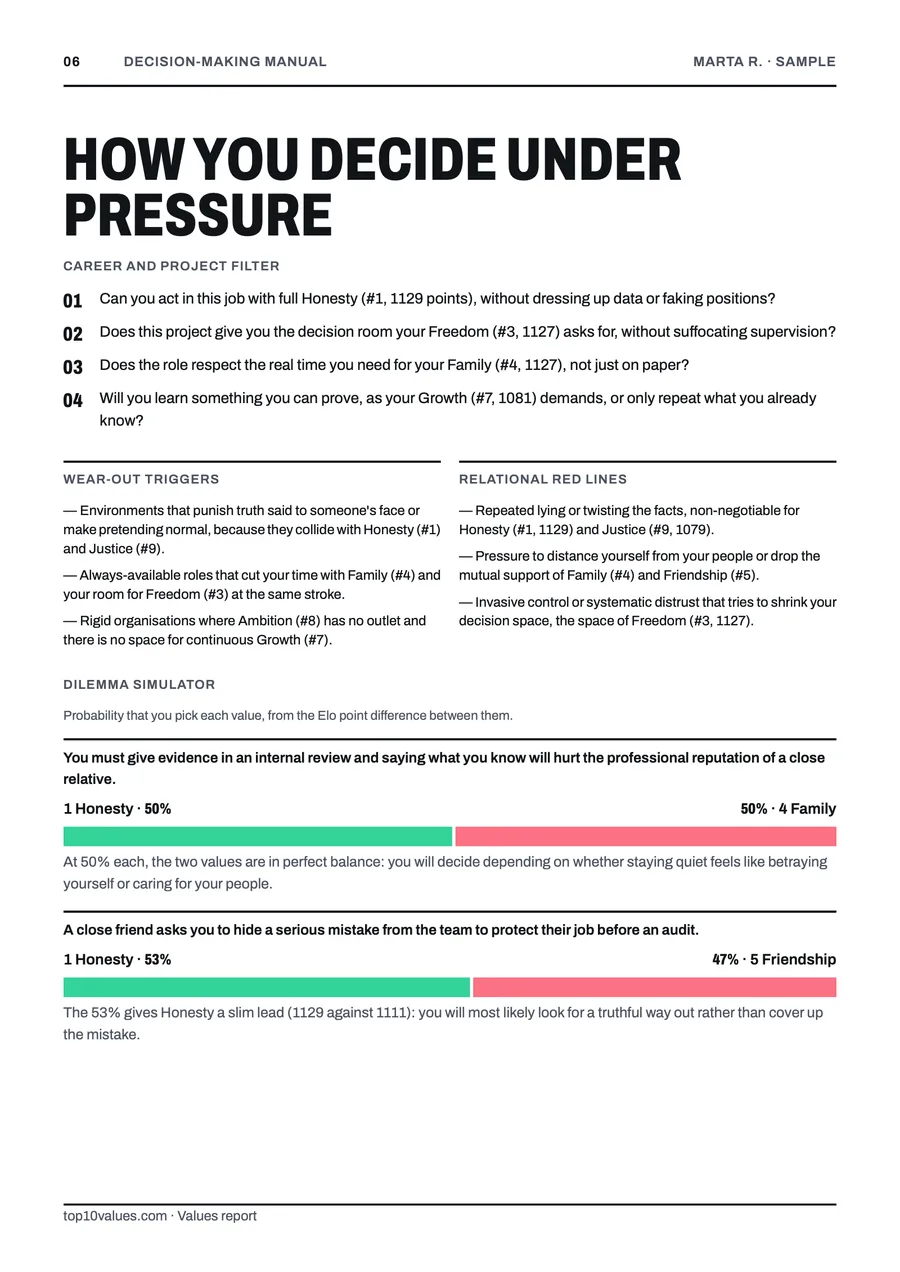
Sample page with fictional data (Marta R.), not yours. Your report is written from your own choices.
Frequently asked questions
What is the difference between excellence and perfectionism?
Perfectionism demands that nothing have flaws and experiences every error as a personal failure; excellence aims for a good standard and reaches it, knowing there will be flaws and that they can be corrected. A clear clue is what happens at the end: the perfectionist feels brief relief and straight away sees what is missing, whereas someone living excellence can say "this is good" and move on to the next thing. Another clue is the relationship with time: perfectionism delays, hands in late or avoids starting so as not to be exposed, while excellence knows when to stop. The psychologists Hewitt and Flett described several forms of perfectionism, among them the one that comes from the pressure you believe others put on you; if your demandingness comes more from fear of criticism than from pleasure in good work, that is a sign to look at it again.
When is it better to settle for "good enough"?
When the cost of polishing further exceeds what the result needs. For an internal message, a draft you will go over with other people, or a household task you will repeat tomorrow, a reasonable standard is enough and saves energy for what does matter. The economist Herbert Simon proposed in 1956 the word satisficing, a blend of "satisfy" and "suffice", to describe choosing an option that meets your criteria instead of searching for the best of all. Barry Schwartz later used that idea to distinguish between people who maximise and people who are content with good enough. Excellence is not polishing everything, but deciding with judgement which jobs call for your best and which call for a good result on time. Be strict where other people could be at risk, such as a dose, an account or a structure, and flexible where only your pride is at stake.
How do you practise excellence in a team without creating pressure?
With clear criteria, enough time and a respectful way of treating mistakes. It helps to define in writing what "done" means for each kind of work, which checks it goes through and who carries them out. It also helps if criticism focuses on the work and not the person, and if good work is recognised out loud. If deadlines make it impossible to meet the standard, the problem is not attitude but planning, and whoever manages the team has to own it. Pressure appears when quality is demanded without time or support, or when getting it wrong carries a personal price. In teams where you can say "I got this wrong" without consequences, mistakes come to light sooner and are corrected better. A simple practice is to close every project with a short review of what was learned, without looking for someone to blame.
Is academic excellence the same as excellence as a value?
Not necessarily. Academic excellence is usually measured with grades, prizes or scholarships, that is, by outside criteria; excellence as a value looks at the care with which you study and the depth with which you understand, whether or not you get the top mark. You can get an A by cramming the night before and understand nothing, or get a B after really grasping the subject and asking awkward questions. Living excellence in study means, for example, redoing an exercise until you know why it works, explaining the lesson to someone else, reading beyond what will appear in the exam, or asking for detailed feedback on your essay. Grades and scholarships can be a consequence of that care, but they are not the value. If the only aim is the mark, the trap appears of studying to pass rather than to know.
What do philosophy and craft traditions say about excellence?
In classical Greece, arete is the excellence of something in what is proper to it: for a knife it is cutting well, and for a person it is living well. Aristotle, in the "Nicomachean Ethics", holds that virtues are acquired through practice, just as you learn a trade by doing it, and that moral excellence seeks a mean suited to each case. Richard Sennett, in our own era, defends in "The Craftsman" the value of doing things well for their own sake. In Japan, the term kaizen refers to continuous improvement through small changes, and is associated with twentieth-century industry. There is also a proverb of Italian origin that Voltaire quoted, "the best is the enemy of the good", which warns that chasing the optimum can stop you achieving something worthwhile. The traditions agree that excellence is a habit that is trained, not a talent reserved for a few.
When Excellence clashes with…
Invented scene. Cecilia is a pastry chef making the cakes for a friend's wedding. Three days before the event, she is unhappy with the glaze on the main cake and wants to redo it from scratch, even though that means two nights with almost no sleep. Excellence is not perfectionism out of vanity: it wants what carries her name to be the best she knows how to make. Balance reminds her that on Friday she has a double shift at the cafe and that she forgot to eat yesterday. Health asks what glaze is worth a week of exhaustion. Kindness brings a different view: nobody at the wedding will see the flaw, and her friend only wants to see her smile. It helps to tell a flaw that matters from one that only its maker can see. She can decide in advance on three things that are not negotiable and let go of the rest. More scenes in conflicting values.