Core values examples: personal and company, with a statement for each
By Juan Alejandre · Published · Reviewed
Industrial engineer and consultant, 25 years working with teams
Core values are the few principles you will not trade away when a decision gets hard. Personal examples include honesty, family, freedom, growth and security. Company examples include integrity, customer focus, excellence, accountability and teamwork. A good example comes with a one-line statement of what it looks like in practice, such as "we tell clients bad news first".
That last part is what most lists leave out. A single word like "integrity" fits on any wall and tells you nothing. A word plus a sentence plus the kind of decision that puts it to the test is something you can check against your own week. This page gives you 20 personal examples and 10 company examples built that way, then a method to cut any long list down to five.
If you want a long list of values with short definitions, the personal values list has 50. Here the goal is different: fewer values, written as behavior.
What counts as a core value (and what does not)
A core value is something you would defend even when it costs you. The simplest check is the cost test: can you name a real situation where holding the value meant losing something, such as money, time, a deal or an easy afternoon? If it never costs anything, it is probably a preference or a nice word.
Advertisement
Four things get confused with values all the time:
| It is a... | Example | Why it is not a core value | The value underneath |
|---|---|---|---|
| Value | Honesty | It guides choices in many situations | Itself |
| Skill | Public speaking | You can learn it and lose it; it says how you do something, not why | Perhaps growth or contribution |
| Goal | Buy a house by 40 | It ends when you reach it | Perhaps security or family |
| Rule | Never reply to email after 7 pm | It is one way to protect something | Perhaps balance or health |
Values are the "why" behind goals and rules. For the longer version of that distinction, see values vs beliefs.
One more word worth separating: a value is a single principle ("honesty"), while a value statement is the sentence that says what it looks like in practice ("I tell people what I think, kindly, before they hear it from someone else"). Examples below always come as a pair.
20 personal core values examples, each with a statement
Each example has the value, a first-person statement and a decision that tests it. The situations are invented. Ask yourself which statements you would sign unchanged, and which make you wince because they would cost you something right now.
Relationships
Family. Statement: "I protect time with my people before I fill the calendar." Tested when a promotion asks for three weekends a month. The entry on family shows how widely the word is read.
Friendship. Statement: "I keep in touch when it is not convenient." Tested when an old friend goes through a bad stretch and you are busy. See friendship.
Love. Statement: "I show up in small ways every day." Tested when you are tired and the other person needs ten minutes of attention. More in love.
Loyalty. Statement: "I do not talk about people behind their backs, even when it would win me an ally." Tested when colleagues are venting about an absent teammate and you are invited to join. Loyalty has a cost: it sometimes means staying quiet.
Trust. Statement: "If I say I will do it, I do it, or I say early that I cannot." Tested when you overcommitted on Monday and Friday arrives. Building trust is mostly the habit of telling people early.
Work and achievement
Ambition. Statement: "I ask for the harder project and accept that I may fail at it." Tested when a safe, comfortable role is on offer. See ambition.
Discipline. Statement: "I do the unglamorous part first." Tested when motivation is low and nobody is checking. Discipline is showing up anyway.
Learning. Statement: "I would rather look ignorant for a minute than stay ignorant for a year." Tested when a meeting uses a term you do not know and everyone nods. Learning costs pride.
Creativity. Statement: "I make something of my own before I consume more of other people's." Tested when the evening is empty and scrolling is easier. Many name creativity and rarely schedule it.
Wealth. Statement: "I build financial room on purpose, and I know what it is for." Tested when a spontaneous purchase conflicts with the number you set. See wealth.
Freedom and security
Freedom. Statement: "I keep my time and choices open enough to change course." Tested when a stable contract would lock you in for five years. The tension with the next value is real; freedom vs security works through it.
Independence. Statement: "I try to solve it myself before I ask, and I ask before I fail." Tested when accepting help would be faster but feels like a loss of control. See independence.
Security. Statement: "I keep a cushion so a bad month is only a bad month." Tested when an exciting but unstable offer arrives. For some people security is what makes other risks possible.
Health. Statement: "I treat sleep and movement as appointments, not rewards." Tested when a deadline invites you to skip both. See health.
Peace. Statement: "I leave a conflict that is only about winning." Tested when you are right and the argument would feed on itself. More on peace.
Character
Honesty. Statement: "I say what I think, kindly, before it becomes a surprise." Tested when a friend asks your opinion of a plan you doubt. The entry on honesty lists other readings, and kindness vs honesty covers the tension.
Integrity. Statement: "I act the same when nobody is looking." Tested when a shortcut would go unnoticed. Integrity is the match between what you say and what you do.
Courage. Statement: "I speak up when it is uncomfortable and I do it early." Tested when you see a mistake in a senior person's plan. Courage is rarely dramatic.
Kindness. Statement: "I assume the other person has a reason I cannot see." Tested when someone is rude to you and you are tempted to reply in kind. Kindness costs you the satisfaction of the comeback.
Justice. Statement: "I notice when a rule works differently for different people, and I say so." Tested when the unfair arrangement happens to benefit you. See justice.
Personal core values for work
You do not need a separate list for work. Take integrity (you refuse to alter a number so a report looks better), trust (you flag a slipped deadline the day you know), courage (you disagree in the meeting, not in the corridor) or learning (you ask for the project that teaches the most). The guide on values at work shows how these play out on a team, and a story behind each value also strengthens your answer in a job interview.
10 company core value statements (written as behaviors)
Company values are usually written for a website. The useful ones are written for a Tuesday afternoon: they say what to do when two reasonable options exist. These are illustrative statements, not quotes from any real organization. Copy the structure, not the words.
1. Integrity. "We tell clients bad news first, and in person where we can." The test is a delayed delivery you could hide for a week. See integrity for the individual side.
2. Customer focus. "We fix the customer's problem before we decide whose fault it was." The test is a refund request where policy and common sense point different ways.
3. Excellence. "We do not ship work we would not use ourselves." The test is a release date that is fixed and a flaw that is small but real. More on excellence.
4. Innovation. "We run small experiments before large bets, and we share the ones that fail." The test is whether a failed trial is reported or buried. The entry on innovation looks at the personal side.
5. Accountability. "When something goes wrong, the owner says so first and proposes the fix." The test is a missed target when blaming another team would be easy.
6. Teamwork. "We share credit in public and give feedback in private." The test is a successful project where one person did most of the visible work.
7. Respect. "We disagree about ideas, never about people." The test is a heated meeting with a junior colleague who is wrong. Respect looks different when the other person has less power than you.
8. Transparency. "If a decision affects someone, they hear it from us before they hear it from the grapevine." The test is a reorganization that is not final yet.
9. Sustainability. "We choose the option we could still defend in ten years, even when it is more expensive today." The test is a cheaper supplier with a weak record.
10. Learning. "Every project ends with one written lesson, and someone reads it." The test is whether the review happens when the next project is already late.
Weak wording and better wording
Most corporate values fail in the same way: they are nouns with no cost. Compare:
| Weak wording | Why it fails | Better wording |
|---|---|---|
| "We value excellence" | Nobody would say they do not | "We do not ship work we would not use ourselves" |
| "We are customer-obsessed" | Cannot be checked on a given day | "We fix the problem before we assign blame" |
| "Integrity is at our core" | Fits every company | "Bad news goes to the client first" |
| "We believe in teamwork" | Says nothing about conflict | "We share credit in public, feedback in private" |
A good statement passes three questions. Could a new hire apply it on day one? Could a manager point to a decision where it cost something? Could someone reasonably disagree with it? If not, it is too vague to guide anything.
Core value statement examples by industry
The same value reads differently in different work. These are orientative sketches, not templates.
- Construction. "No schedule is worth a shortcut on site; anyone can stop a job."
- Technology. "We publish what our product cannot do yet."
- Healthcare. "We explain what we are doing before we do it, every time."
Before you put any line in a business plan, test it on three recent decisions. A value that would have changed none of them is decoration.
From examples to your own five
A list of 30 examples is a menu. What you want is five that you recognize as yours. This method works for a person or for a small team, and the pairwise step is the same one the game uses.
- Mark everything that tugs (5 minutes). Go through the examples above, or any list, and mark every value that gives you a small reaction, either a yes or a "that stings". Aim for 15 to 20. Do not decide yet.
- Cut to 10 by cost (5 minutes). For each marked value, ask the cost question: when did this last cost me something? Keep the ones with an answer. If you cannot recall a cost, the value may still be a wish.
- Compare in pairs until five remain (10 minutes). Take two values and ask: if I could only keep one, which? Do not average, do not pick "both". Play a round of pairs and tally how often each value wins. The five with the most wins are your working set.
- Write one statement for each (10 minutes). Use the template below.
- Check against last week. Open your calendar and bank statement. Does the week reflect the five? The gap is useful information, not a verdict.
Template to copy for each value:
Value: ______ Statement: "I ______ even when ______." A decision it will test this month: ______ What it would cost me: ______
The 10-minute version: write the 10 you recognize fastest, circle the three you would keep above all, and write one sentence for each.
Pairwise comparison beats ranking a list directly because it forces trade-offs: on a list everything seems important, in a pair you must give one up. That is the mechanism behind the top10values game: 50 values compared in pairs, and a Top 10 from your choices. For the ordering step, see values hierarchy.
Where personal and company values meet
Your personal values and your employer's stated values are two lists that sometimes overlap and sometimes do not. A full match is not required; what matters is whether the gap is one you can live with.
A practical move: put your five next to the company's written values. Beside each company value, write a recent decision that shows it in action. Values with no decision next to them are the ones to ask about. If the company rewards what you refuse to do, that is a real clash, and values at work covers what to do next. When two of your own values pull apart, conflicting values gives a way to decide.
Common mistakes
- Choosing values that sound good. If everyone would pick it, it will not help you decide. Look for the ones that cost something.
- Keeping 12 values. At that size none of them is a priority. Three to five is the range where you can remember them.
- Writing statements nobody can verify. "We care about people" cannot be checked. "We answer every support ticket within a day" can.
- Copying another company's list. Employees spot borrowed values, and they go unused.
- Treating the result as permanent. A move, a new job or a loss can reorder your list. Review once a year.
How top10values fits
top10values lets you compare 50 values in pairs and gives you a ranked Top 10 from your choices. It is a tool to organize your own thinking, not a validated psychological test. The methodology page explains how comparisons become a ranking, and the values directory lets you read each value before deciding whether it belongs on your list.
Frequently asked questions
What are examples of core values?
Five personal ones: honesty ("I say what I think, kindly"), family ("I protect time with my people"), freedom ("I keep my choices open"), growth ("I take on what stretches me") and security ("I keep a cushion for bad months"). Five company ones: integrity ("we tell clients bad news first"), customer focus ("we fix the problem before we assign blame"), excellence, accountability and teamwork, each with a behavior attached.
How many core values should a person or company have?
Three to five is the usual range, because that is how many you can remember and apply under pressure. Ten is a good starting list to cut from.
What is a core value statement?
A core value statement is a short sentence that pairs a value with the behavior that shows it. "Integrity" is the value; "we tell clients bad news first" is the statement. A useful one names an action, can be checked on a given day, and would sometimes be inconvenient.
What are good core values for work?
There is no universal list. Three common ones are integrity (you do not alter numbers to look better), accountability (you say first when something went wrong) and respect (you disagree about ideas, not people). Each works because you can name the decision that tests it. See values at work.
What is the difference between personal and company core values?
Personal values describe what matters to you across your whole life; company values describe how an organization wants its people to act when they decide for it. They can overlap, but one does not replace the other. The useful question is whether daily decisions match the words.
Can an online values test tell me my core values?
It can help you organize your thinking, but it does not decide for you. A comparison tool shows which values you pick when you must choose, and you then read that against your real week. If something in the result feels wrong, trust the feeling and look at why. See personal values test for what such a tool can and cannot do.
Related guides
- Personal values list: 50 values grouped by area, for when you want more vocabulary.
- Knowing my personal values: six exercises to find which ones are yours.
- Values at work: how values show up on a team and what to do when they clash.
- Values hierarchy: how to rank the values you chose.
Start today
Pick five examples from this page that you would sign without editing, and write one sentence each that finishes "even when...". That is already a working set. When you want to check it against pairwise choices, play the game and get your Top 10, then compare it with your five.
Sources
Find your top 10 values with 100 quick comparisons
What does the paid report include?
When you finish the 100 comparisons you will see your Top 10 on screen. If you want to go further, there is a PDF report on your personal values: €9.95 (VAT included), one-off payment. To buy it you need to save your game with a Google account.
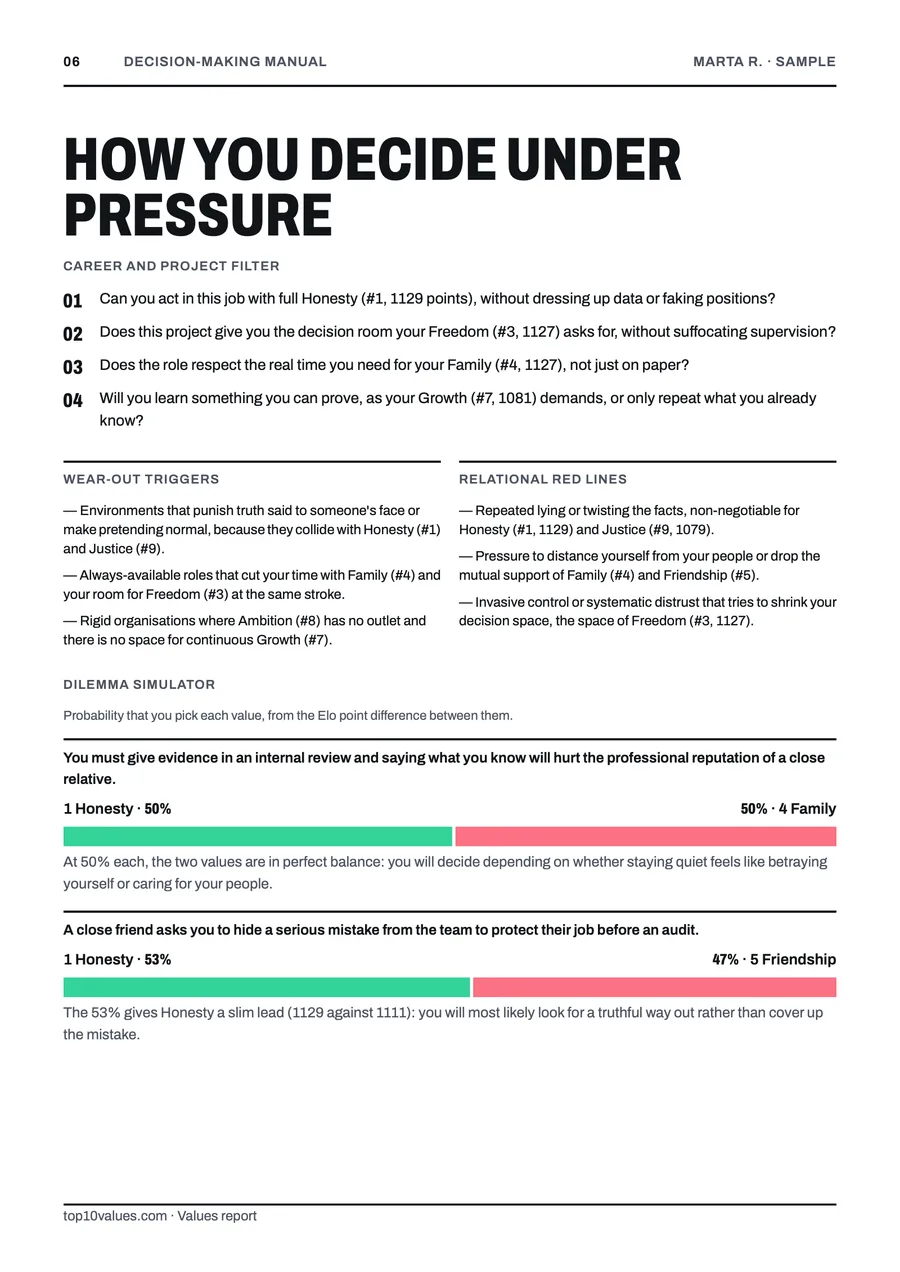
Sample page with fictional data (Marta R.), not yours. Your report is written from your own choices.