Family values: 10 examples with scenes and a half-hour exercise to name yours
By Juan Alejandre · Published · Reviewed
Industrial engineer and consultant, 25 years working with teams
Family values are the things a household treats as important, and you can see them in how people live together: how they talk at the table, who does the dishes, what gets celebrated and what is never let slide. Nobody has to have written them down. Most families already have them. What is usually missing is the wording.
This page does not define what a family is; for that, see the entry on family. Here you get ten examples, each with an invented scene, a half-hour exercise for agreeing on your own, what to do if the two adults disagree, how to bring teenagers in, common mistakes and a short FAQ.
It is not parenting advice and it does not say what a family should look like. Every home has its own values, and the lists below are material to think with, not a model to copy.
Ten examples of family values
These are invented scenes, with made-up names. They show how one value can turn into very different habits from house to house. Yours may look nothing like them, and that is fine.
Advertisement
1. Respect
Example. At the Hendersons' table, when someone is telling a story, phones go face down. It started because Maya, nine, said she felt like she was talking to the top of everyone's head. Now respect there means waiting your turn and hearing someone out, even when you think they are wrong. The entry on respect covers other ways to read it.
2. Honesty
Example. Tyler, eleven, broke the garage window with a baseball and covered the gap with a cardboard box. His dad found it that evening. There was no shouting. He said, "I would rather hear it from you the same day, even when it is bad." For this family, honesty means being able to say "I messed up" without it changing how much they like each other. More in the entry on honesty.
3. Trust
Example. Seventeen-year-old Hannah texts her parents when she will be home, and they do not message her every half hour. The one night she is late, their first question is "Are you okay?" and not "Where were you?" Trust there is built from small agreements that get kept, plus room for them to slip occasionally. See trust for more.
4. Gratitude
Example. In Margaret's house, Sunday dinner ends with each person naming one thing from the week they appreciated, even something as small as someone starting the coffee. Sometimes everyone laughs; sometimes somebody is quiet for a while. Nobody is required to feel good. It is a habit of noticing. The entry on gratitude goes further.
5. Love
Example. Julian is not someone who says "I love you" out loud. But every morning he packs his son's lunch and tucks in a note with a badly drawn cat. In that house, love is shown by showing up, again and again, more than by saying it. Every family has its own language for this; the entry on love looks at several.
6. Time together
Example. The Whitfields have one fixed rule: Thursday dinner is not up for negotiation. No plans, no screens, and whoever cooks picks the menu. Some weeks it lasts twenty minutes and nothing important comes up. For them, putting each other first does not mean special outings. It means a slot in the week that nobody trades away.
7. Responsibility
Example. At Paula's, nobody "helps" clear the table, because everyone lives there. A sheet on the fridge lists the week's jobs and rotates every Monday. When someone forgets theirs, there is no lecture, just "your turn today, mine tomorrow." Responsibility here looks more like a fair split than a demand.
8. Humor
Example. The Callahans keep a running list of famous disasters: the year Grandpa used salt instead of sugar in the pie, the birthday cake that collapsed. They retell them every Christmas. Laughing together at what went wrong, without making fun of anyone, is how they say that mistakes are survivable.
9. Generosity
Example. Each autumn, Lola and her kids go through the closets and set aside what nobody uses, then drop it at the neighborhood collection point. Nobody gives a speech. What gets passed on is a habit: what you do not need can help someone else, and sharing is not a sacrifice.
10. Independence
Example. At fourteen, Alex chooses his own clothes with a monthly budget, and sometimes gets it wrong. His parents give an opinion if asked. For them, letting each person decide about their own things is a way of saying "we think you can handle it," even on days they would prefer to decide themselves. See independence.
None of these is the "correct" list. In some homes the first value is loyalty, tradition, faith, effort, simplicity or curiosity. If none of the ten fits, your family probably runs on others. The personal values list has the 50 values compared in the game, in case you want more vocabulary.
Exercise: a 30-minute values meeting
Family values usually form without being discussed. This exercise puts them on the table. It is designed for the adults in the home; older children who are interested can join at step 3. You need half an hour, paper, and a phone or laptop.
- Each adult, separately (10 minutes). Each of you plays the top10values game on your own device. After about 100 comparisons you get an ordered Top 10; if you want to split the time, do it before the meeting. Write down only your first five, without looking at the other person's. You can start without creating an account.
- Share (5 minutes). Read your five aloud, one after the other. No commenting, no correcting. Underline the ones that match and the ones that appear on only one list.
- Agree on three (10 minutes). Choose three values for this stage of your household. They can be shared or not. If a teenager is joining, ask: "Which of these three do you think already shows up at home, and which does not?"
- One visible behavior each (5 minutes). Turn each value into a sentence that starts "In this house..." and describes something you could actually see. For example: "In this house, if you break something, you tell us first and we fix it together" (honesty), or "In this house, Thursday dinner stays on the calendar" (time together).
- Set a review date. Put the three sentences on a piece of paper where everyone sees it and look again in three months. If one is not being lived, that is not failure: maybe it was too ambitious, or it no longer describes what matters.
A value with no behavior floats in the air; a behavior with no value turns into a rule nobody understands. The point is to connect them.
When the two adults' values do not match
This is common. One person puts security first and the other puts adventure; one leans on tradition, the other on independence. It does not mean one is right. Each simply ranks things differently.
- Start with what you share. There are nearly always one or two values in common, and they make a solid base.
- Ask what sits underneath. "What worries you if we do it my way?" often exposes a specific value under the argument.
- Look for behaviors, not winners. Two different values can live together once each becomes a concrete habit: one weekend with a full plan, the next with nothing planned, for instance.
- Accept that thirty minutes will not settle it. Leaving with a provisional agreement is enough.
If you want a structured version for two people, see values in a relationship. When one of you is torn between two values of your own, conflicting values offers a way through.
Teenagers: ask, do not impose
From a certain age, values that are dictated tend to bounce off, while values that are talked through sometimes stick. There is no guarantee, but a question opens more doors than a lecture.
- Begin with what they already do. "You helped your brother with his homework this week and nobody asked you to. What made you do it?"
- Ask for their version, not their approval. "What feels most unfair about how this house runs?" Then listen without defending.
- Offer the exercise as an invitation. If they want to play the game and show you their Top 10, great. If not, that is a legitimate answer.
- Expect different values. A seventeen-year-old who puts freedom or friendship first is not necessarily rejecting the family's values.
Common mistakes when naming family values
- Copying a nice-looking list. If "respect, honesty, hard work" hangs in a frame but nobody sees them in daily life, they are not yours.
- Choosing too many. With ten, nobody remembers any. Three is enough.
- Using them as accusations. "In this family we are honest" said mid-argument works like a charge. Mention values outside the conflict.
- Assuming they never change. A birth, a move or a loss can reorder them. Revisit once a year.
- Writing sentences nobody could check. "We care about each other" is hard to see. "We eat together on Thursdays" is easy.
Frequently asked questions
What are family values?
They are the things a family treats as important, reflected in how they live together: how they talk, split chores, celebrate and what they expect of each other. They can be spoken or unspoken. The entry on family covers the value itself; this guide is about how to put words on it.
How many family values should we have?
Three is manageable: you can remember them and turn each into a behavior. If five come up, keep the three that are hardest to live out, or the three you miss most right now.
Are there good and bad family values?
This page does not judge. Some values a family puts first and others come second, and that shifts over time. What is worth checking is whether what you say matters matches what you do.
Can one adult do this alone?
Yes. Do step 1 and choose your five, then pick three and write the "In this house..." sentences. If you have children old enough to talk about it, step 3 can be a conversation with them. Your result describes what you choose today, not who you are; the methodology page explains the calculation.
Related guides
- Values in a relationship: the exercise for two, useful when the adults' values differ.
- Honesty vs loyalty: what to do when telling the truth is costly inside a family.
- Conflicting values: a method for choosing between two values that clash.
Next step
Family values work like the unwritten rules of a place: you notice them most when someone breaks one. Putting them in words, with examples of what each person does, saves misunderstandings. A good first step is to play the game and get your Top 10, then bring it to the table. If you would rather understand the format first, read how to take a personal values test.
Sources
Find your top 10 values with 100 quick comparisons
What does the paid report include?
When you finish the 100 comparisons you will see your Top 10 on screen. If you want to go further, there is a PDF report on your personal values: €9.95 (VAT included), one-off payment. To buy it you need to save your game with a Google account.
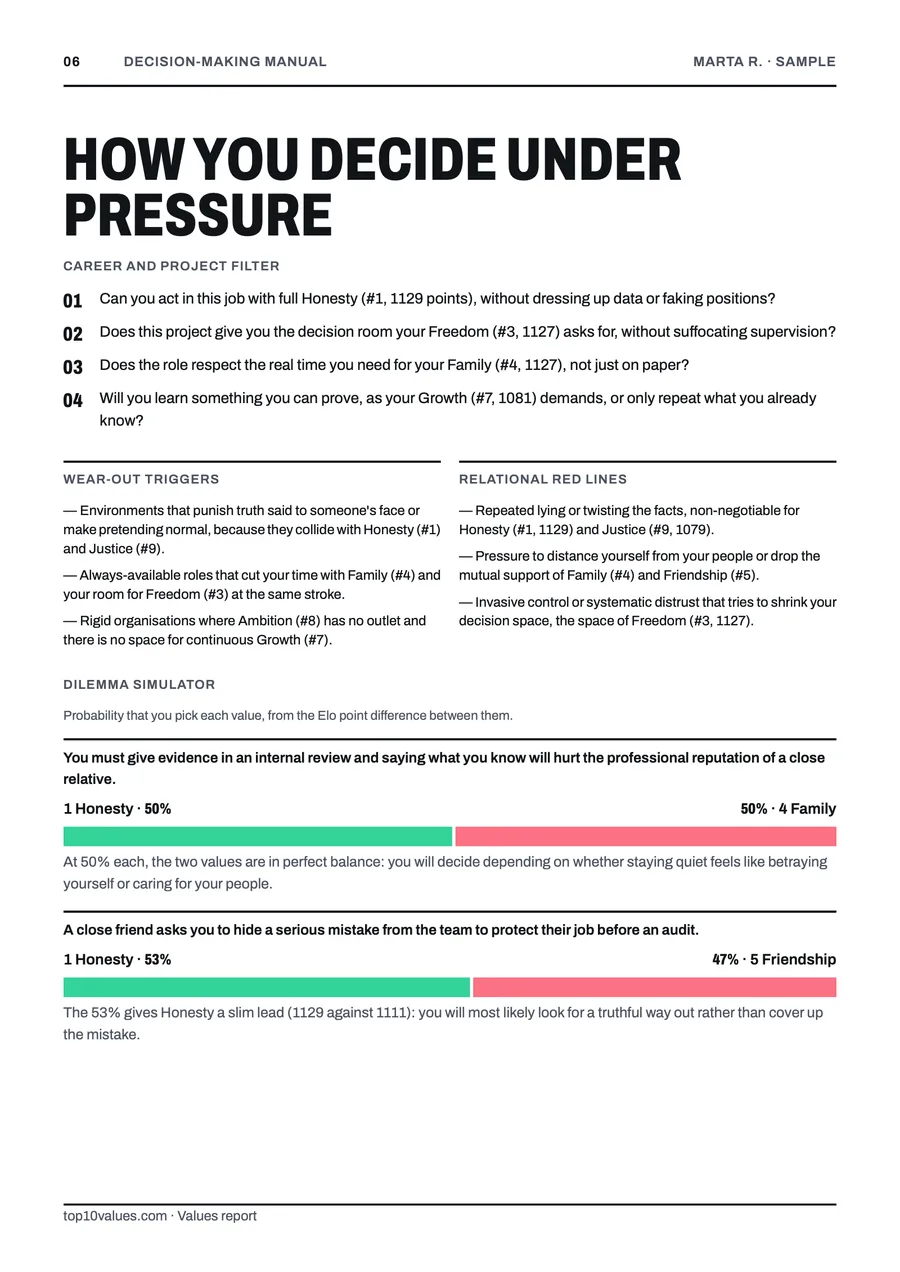
Sample page with fictional data (Marta R.), not yours. Your report is written from your own choices.